Est. 2005 · UK-wide trenchless installations07920 553 578·enquiries@swdirectionaldrilling.co.uk
Trenchless Services
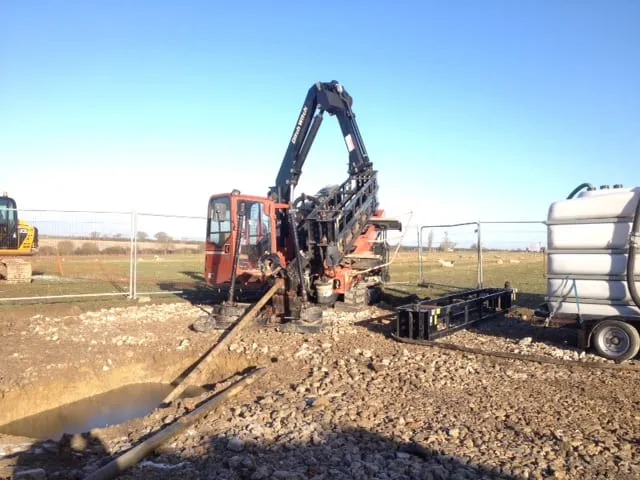
Steered, trenchless installation of pipes, ducts and cables under roads, rivers, railways and sensitive ground, up to 900mm diameter and 500m in a single shot, with no open-cut in between.
Horizontal directional drilling (HDD) is the trenchless method behind most modern utility and pipeline crossings. Instead of digging a trench across a road, river or railway, we drill a steered bore along a designed path and pull the new pipe back through it, so the surface above stays intact.
S.W.Directional Drilling Ltd has been installing pipes and ducts this way across the UK since 2005. We sit in the gap between general groundworkers, who can't take on the technical crossings, and the national giants, who are slow and expensive on smaller and mid-size schemes. You get senior expertise, in-house design and CAD, and a crew that turns up and solves the problem.
We also run our own machine shop. After more than twenty years building drilling tooling, we make a lot of our own reamers and support kit in-house, custom to the job, and usually faster than waiting on an off-the-shelf part that often has to ship in from America or Europe. It is a big part of why we can take on bespoke and awkward crossings that other contractors cannot or will not.
New to this? Our plain-English guide to trenchless methods and our explainer on the types of directional drilling cover the basics with no jargon. Wondering what a crossing should cost? Our UK directional drilling cost guide explains how the price is built up and what moves it.
A recent example. We drilled in the HV cable ducts for a battery-storage grid connection on a live National Grid site. See the Iron Acton cable-duct case study, with site video.
Capability at a glance
| Pipe / duct diameter | Up to 900mm |
|---|---|
| Bore length (single shot) | Up to 500m |
| Products installed | Water, gas, HV/EHV cable ducts, fibre, drainage, sewer rising mains |
| Pipe materials | HDPE / MDPE, steel, ductile iron, clay-lined |
| Ground | Clay, sand, gravel, made ground, weathered & solid rock |
| Steering / control | Walkover locator or wireline (Paratrack) for deep / long crossings |
| Typical accuracy | Survey-controlled entry, exit & depth to spec |
| Coverage | UK-wide · established 2005 |
Figures are typical. We confirm what's achievable from your levels and ground conditions.
The method
Every crossing follows the same three stages, scaled to the job.
Drilling fluid, a bentonite and water mix, does the hidden work throughout. It cuts and carries spoil, supports the bore wall, cools the tooling and lubricates the pullback. Managing it well is most of what separates a clean crossing from a stuck one.
The pilot bore is the steered stage, and how we track it depends on the crossing. Our guide to how directional drilling is steered explains walkover, wireline and gyro guidance, and why a crossing under a motorway, railway or river is tracked differently to one under a minor road.
Where it matters most
Directional drilling comes into its own wherever a trench is impractical, expensive or simply not allowed.
We drill through clay, sand, gravel, made ground and weathered rock as standard, and switch to dedicated tooling where the ground turns to solid rock.
See it in action
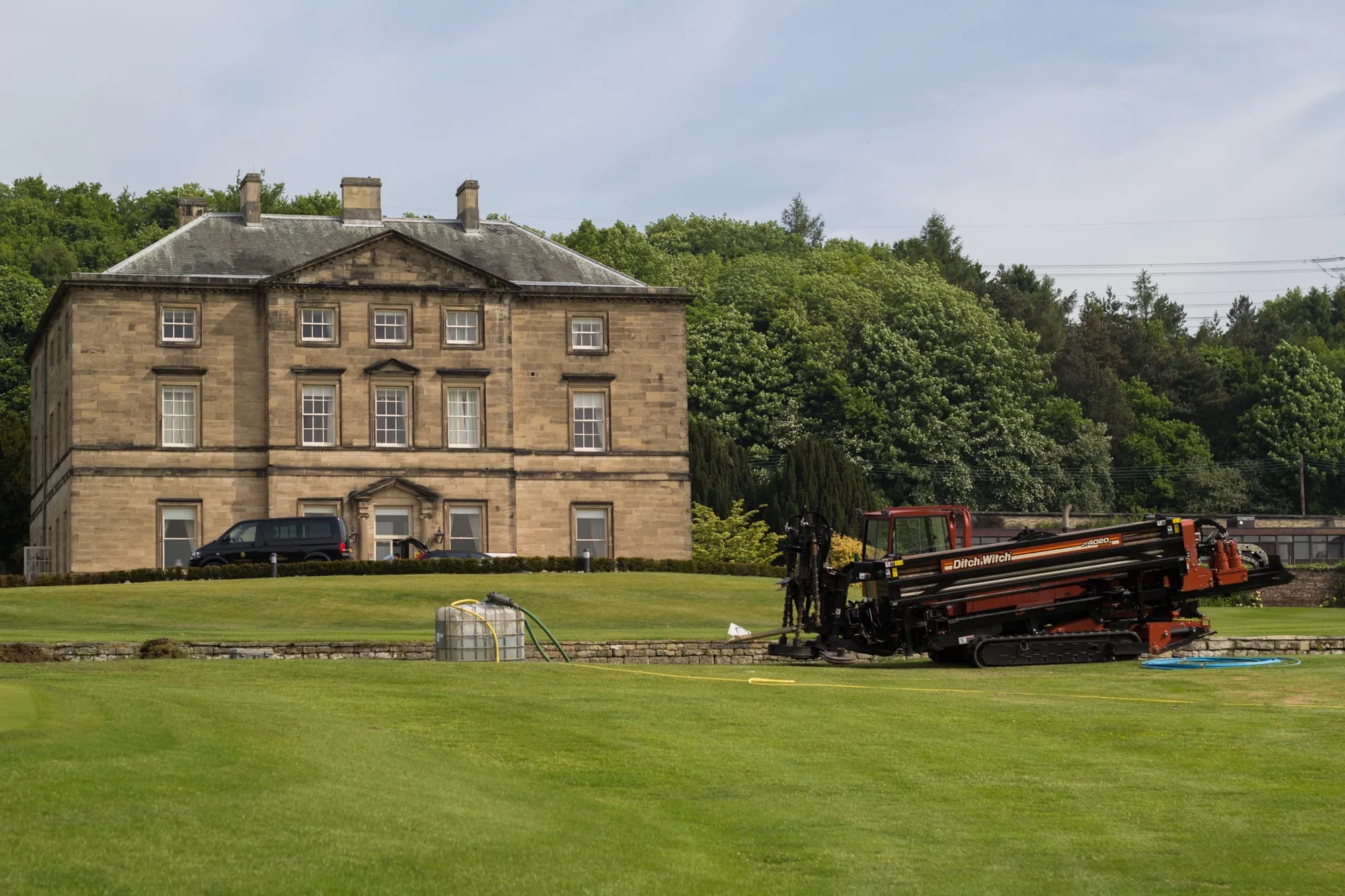
A short film of one of our crossings. Installing high-voltage cable ducts for a grid connection at Iron Acton, drilled under the access road and a protected hedge and into a live National Grid substation.
Questions answered
Horizontal directional drilling is a trenchless method of installing pipes, ducts and cables underground without open-cut excavation. A steered pilot bore is drilled along a designed path from an entry point to an exit point, the bore is enlarged by back-reaming, and the product pipe is then pulled back through it. It lets us cross roads, rivers, railways and sensitive ground from compounds either side, leaving the surface in between untouched.
We routinely install single bores up to around 500m in one shot and to diameters up to 900mm, at depths set by the design. That is typically a few metres under a road, up to 15m or more beneath a river or railway. Length, diameter and depth all interact with the ground conditions, so we confirm what is achievable from your levels and a ground investigation.
On most utility and duct work we install from 32mm service ducts up to 630mm pipe, and on large-diameter drainage and pipeline crossings up to 900mm. Larger or multiple ducts can be installed in a single bundled pull where the design allows.
The pilot bore is tracked continuously and steered to a designed profile. On shallow crossings we use a walkover locator. On deep or long crossings, or under live infrastructure where surface tracking is not possible, we use a wireline steering system. Entry, exit and depth are controlled to the project specification and recorded as an as-built.
No, that is the point of it. We work from a compound at each end, with small entry and exit pits or a surface launch. The ground between the two compounds is left undisturbed, which is what makes HDD suitable under roads, watercourses, hedgerows, SSSIs and live operational sites.
It depends on diameter, length, depth, ground conditions and access, so there is no flat per-metre rate. For the right crossing HDD is usually far cheaper than open-cut reinstatement or tunnelling, and faster. Send us your drawings or levels and we will give you a free budget price. Our UK directional drilling cost guide explains exactly how the price is built up.
Related services
When the bore runs into rock, we switch to a purpose-built All Terrain rock system.
View service →For large steel casings, or ground too coarse to steer, a rammed casing is often the answer.
View service →Gravity drainage drilled to falls, large-diameter outfalls and sewers without a trench.
View service →Send us your drawings, levels or a site plan and we'll tell you whether we can directional-drill it, and what it should cost.