Est. 2005 · UK-wide trenchless installations07920 553 578·enquiries@swdirectionaldrilling.co.uk
Trenchless Services
The fast, low-cost trenchless method for small-diameter service ducts, installed under driveways, gardens, paths and roads with nothing more than a small pit at each end.
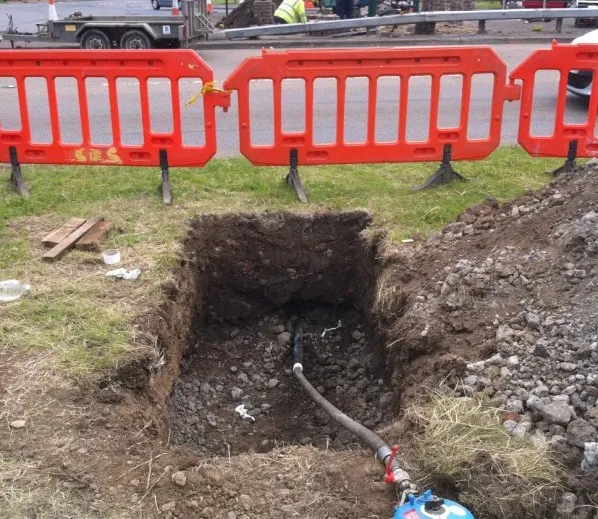
Impact moling is the simplest trenchless method we offer, and often the cheapest way to get a new service across a finished surface. A pneumatic "mole" drives itself through the soil under compressed air, compacting a bore as it goes and towing the new duct in behind it.
The mole is a torpedo-shaped pneumatic piercing tool. Inside it, an air-driven piston hammers forward against the nose, punching the tool through the ground one blow at a time. Because it displaces and compacts the soil instead of removing it, there is no spoil to clear and no trench to reinstate, just a neat bore with the new pipe pulled through it.
Capability at a glance
| Bore diameter | 45 to 180mm typical |
|---|---|
| Typical run length | Up to ~25m per shot |
| Spoil | None, the soil is displaced rather than excavated |
| Installs | Water, gas, electric & telecoms service ducts |
| Best ground | Clay, silt & compactable soils |
| Disruption | Small launch & reception pits only |
| Coverage | UK-wide · established 2005 |
Moling suits short, small-diameter runs in compactable ground. Beyond that we step up to directional drilling.
The method
Questions answered
Impact moling is a trenchless way of installing small-diameter pipes and ducts using a "mole", which is a torpedo-shaped pneumatic piercing tool. Driven by compressed air, the mole hammers its own way through the soil, compacting the ground aside to form a bore rather than digging a trench. A new duct or pipe is pulled in behind it. It is the cheapest, quickest trenchless method for short service runs under driveways, gardens, paths and roads.
Yes. "Moling", "mole boring" and "impact moling" all refer to the same technique. The pneumatic tool that does the work is called a mole, which is where the name comes from. You will also hear it called soil displacement or impact piercing.
Moling is for small-diameter services such as water, gas, electricity and telecoms ducts, typically 45mm to 180mm, over short distances up to around 25m in a single shot. For larger diameters or longer, steered crossings we move up to directional drilling.
No, that is the appeal. We only need a small launch pit at one end and a reception pit at the other, and the ground in between is left untouched. It is ideal for getting a new service across a finished driveway, garden or carriageway without digging it up and reinstating it.
Moling is unguided and relies on compactable soil, so it is less suitable in rocky or gravelly ground, over long distances, or where the line and level must be exact. In those cases we recommend directional drilling or auger boring instead, and we will tell you straight which one your job needs.
Related services
For longer runs, larger ducts and steered, survey-controlled crossings.
View service →Pit-launched casing crossings, with an honest look at when each method is the right call.
View service →For larger steel casings under roads and railways.
View service →Tell us the duct size and the distance to cross and we'll confirm whether moling is the quickest, cheapest option for you.