Est. 2005 · UK-wide trenchless installations07920 553 578·enquiries@swdirectionaldrilling.co.uk
Design, Survey & Support
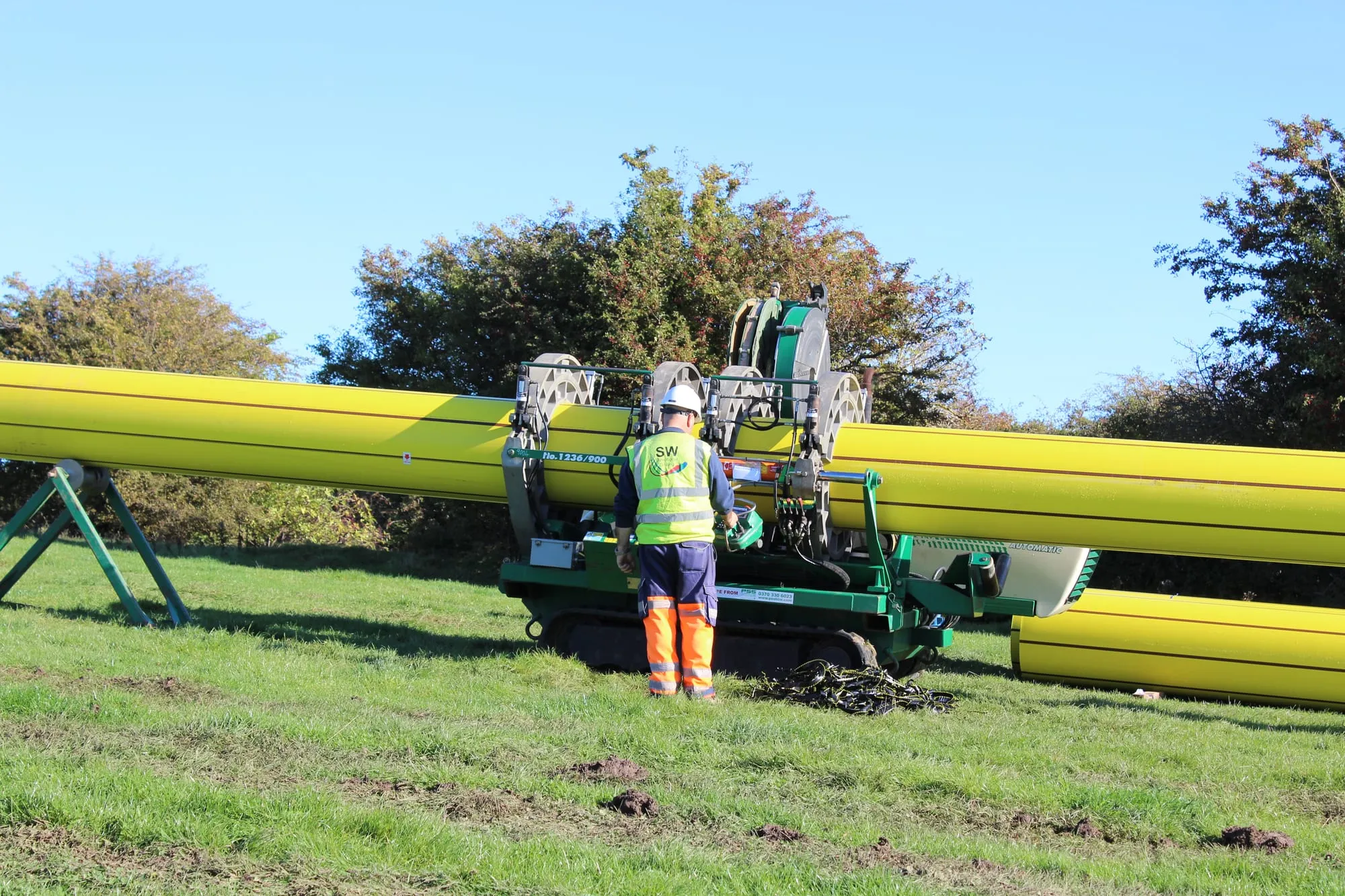
We make up the pipe string ourselves. HDPE butt-fused and electrofused, steel welded by coded welders, de-beaded where it matters, ready to pull straight back through the bore.
A trenchless crossing needs its pipe ready before it goes in. On a directional drill the whole string is pulled back through the bore in one length. On a pipe ram the steel casing is welded up and driven through. The installation itself is the more complicated, higher-risk part of the job, but preparing the pipe is time-consuming work in its own right, whether that is HDPE or steel welding for directional drilling or steel pipe welding for pipe ramming. We do it ourselves rather than wait on a third party, which keeps the programme tight and the responsibility in one place.
For plastic pipe and ducts we butt-fuse and electrofuse HDPE, and de-bead the welds where cables or flow need a clear bore. For steel, our coded welders make up casings and pressure pipe. We can supply the pipe as well, so a crossing turns up as a single package. Pipe delivered, fused, de-beaded and drilled in.
We weld up the full HDPE range, whatever the pipe is carrying: electricity and telecoms ducts, gas and water mains, protective water-barrier pipe, rising mains and gravity sewers, and chemical pipe. If it is HDPE, in sizes up to 1200mm, we can make it up. We weld to the SDR the duty calls for, most often PE100 in SDR11 and SDR17. The SDR sets the wall thickness and so the pressure rating, SDR11 rated to 16 bar and SDR17 to 10 bar, matched to whether the line is a pressure main or a gravity run.
Straight pipe comes in individual lengths, typically 6m and 12m, and in some cases 13.5m or 18m, which we butt-fuse end to end into the string. For smaller-diameter runs, typically up to 180mm, we also supply coiled HDPE in continuous lengths up to 125m, along with the coil trailers. The coil trailer acts to distribute the pipe in a controlled manner so it can be pulled in safely, so a crossing can go in with few joints or none at all.
The string for a directional drill is always butt-fused, never electrofused. An electrofusion fitting sits proud of the pipe and won't take the loads of the pull-back, so it can't be dragged through a bore, the drilled string has to be one continuous butt-fused length. Electrofusion earns its place around that drilled length: joining down in the pit or trench where a butt-fusion machine can't reach, connecting into existing pipework, and fitting in ancillaries like washouts, air valves and service valves. On a run of installations one after another, it also lets us joint each section and backfill straight away rather than leaving the excavation open, which keeps the site moving and safer.
Welding at a glance
| HDPE / PE pipe | Butt fusion & electrofusion, up to 1200mm |
|---|---|
| Pipe types | Electric, telecoms, gas, water, water-barrier, rising mains, gravity & chemical HDPE |
| Pressure rating | PE100 in SDR11 (16 bar) & SDR17 (10 bar), matched to the duty |
| Coiled pipe | Up to 180mm, supplied in lengths up to 125m with coil trailers for a safe pull-in |
| Steel pipe | Coded welders for steel casings & pressure pipe |
| De-beading | Internal weld bead removed so the bore runs clear |
| Clear duct | Beadless HV duct to ENATS 12-24 as an alternative to de-beading |
| Ancillaries | Washouts, air valves & service valves fitted in by electrofusion |
| Supply | We can supply the pipe & ducts as well as weld them |
| Output | A continuous pipe string, fused and ready to pull in |
| Where | On our own crossings or as a standalone fusion service |
Diameters and standards confirmed per job. We can fuse your pipe or supply and fuse our own.
Why de-beading matters
Butt fusion leaves a small bead of material on the inside of the pipe at each weld. Left in place on a cable duct, that bead snags cables as they are pulled through. On our duct crossings we remove the internal bead so the bore runs clean from end to end, and the cables draw through without catching. It is a small detail that saves a lot of grief on site, which is why we build it into the way we make the string up.
On high-voltage cable work we can also use a clear-duct system instead, a beadless HV duct to ENATS 12-24 whose chamfered joints fuse without leaving an internal bead at all, so the bore is clear from the start with no de-beading needed. Whether we de-bead a standard fused duct or run a beadless clear-duct system, the result is the same: cables that pull straight through.
Questions answered
Butt fusion is how polyethylene (HDPE / PE) pipe is joined. The two pipe ends are heated against a hot plate, then pressed together and held under pressure while the joint cools, fusing the pipe into one continuous length that is as strong as the parent pipe. It is the standard way to make up a pipe string for a directional drill, because the whole string has to be pulled back through the bore in one go.
Not on the drilled string itself. The pipe pulled back through a directional bore is always butt-fused into one continuous length, because an electrofusion fitting sits proud of the pipe and won't survive the pull. Electrofusion comes in around that drilled length: joining down in the pit or trench where a butt-fusion machine can't reach, connecting into existing pipework, and fitting in ancillaries such as washouts, air valves and service valves. On a run of installations one after another it also lets us joint each section and backfill straight away rather than leaving the excavation open, which keeps the site moving and safer.
Yes, we de-bead the welds where the job needs it. Butt fusion leaves a bead of material on the inside of the pipe at each joint. For cable ducts and for some flows that bead is removed so cables pull through cleanly and the bore runs clear. On high-voltage cable work we can also run a beadless clear-duct system to ENATS 12-24 instead, whose chamfered joints fuse without leaving an internal bead in the first place. Either way, de-beading or clear duct, the cables pull straight through.
Yes. Alongside HDPE butt fusion and electrofusion we have coded welders for steel pipe, used for steel casings on pipe ramming and for steel pressure pipe. So whether the carrier is plastic or steel, we can make the string up.
Both. We can supply the pipe and ducts as well as fuse them, so the pipe string arrives at the bore as one job rather than several. We can also fuse pipe you have supplied, or work as a standalone fusion service on someone else's site.
Related services
Tell us the pipe or duct, the diameter and the length, and we'll supply it, fuse it, de-bead it and pull it through the bore.