Skip to content
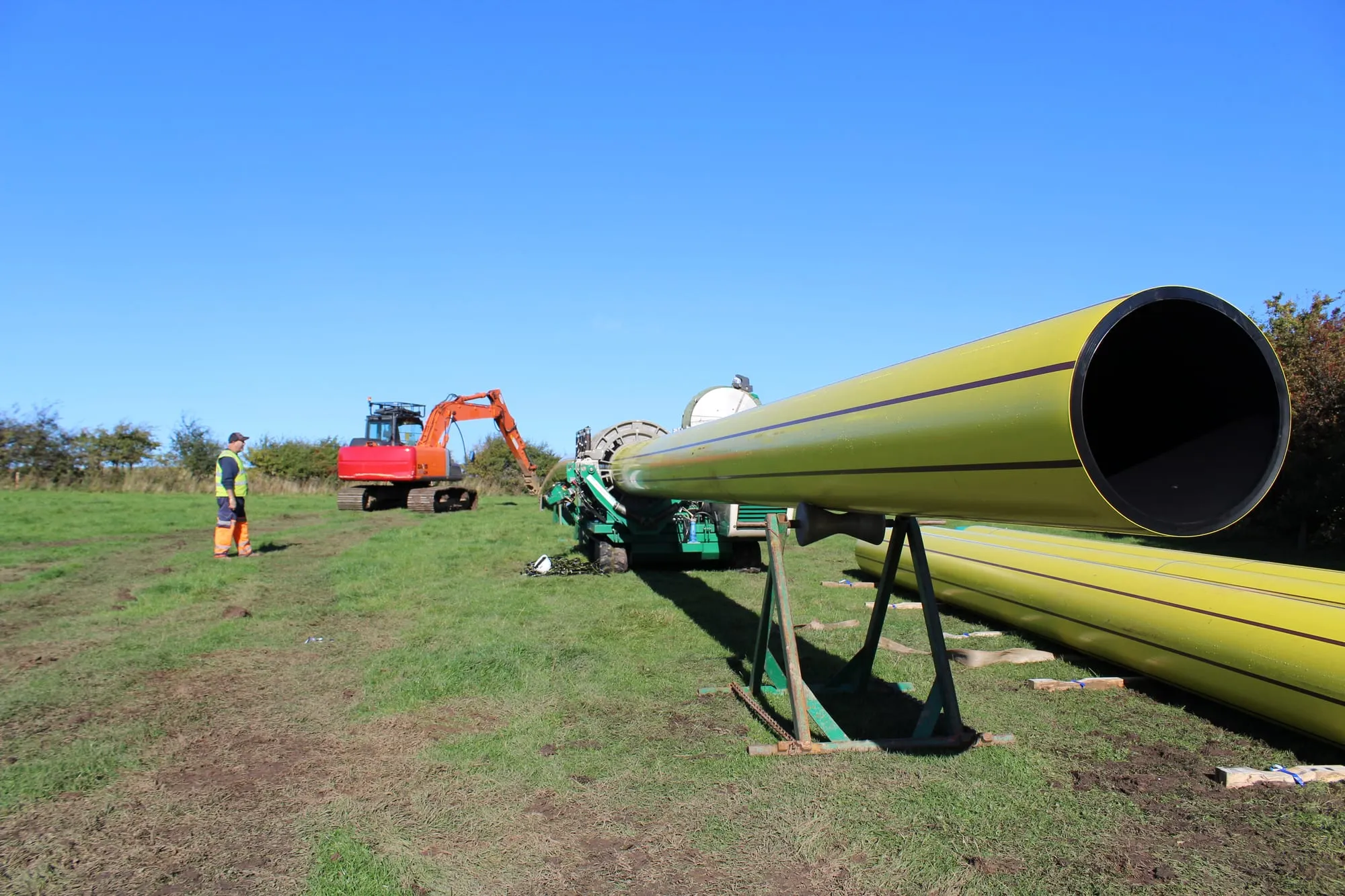
Large-diameter pipe being welded on site before a trenchless installation

Crossing Solutions · Airports

Airport trenchless installation

We install drainage, power and comms ducts beneath operational airport ground without trenching across it, keeping taxiways, access roads and rail terminals in use. Planned around the airport's safety and permit regime.

  • Airside & landside
  • Operations kept running
  • Drainage, power & comms ducts
  • Minimal surface disruption

Airport installations

Below the airport, with it still running

Airports are operational ground where an open trench across a taxiway, apron or access road is rarely an option. Drilling installs the service below the surface from a pit clear of the live area, so the airport keeps working. It is the same under-road and under-rail capability we use everywhere, applied to airside and landside service routes.

We have drilled twelve four-way duct runs at Heathrow, crossed two live runways at Walney Aerodrome on the Cumbrian coast, and crossed live Network Rail track at the Southend airport rail terminal in a single nightshift. Closer to home we have run cable ducts and drainage in at Newcastle and Teesside airports. The crossing is designed and drawn in-house, with the settlement and loading calculations and any Network Rail or airport approvals sorted before the drilling starts, and the programme built around the airport's possessions and permits.

A job we drew up

Two runway crossings at Walney Aerodrome

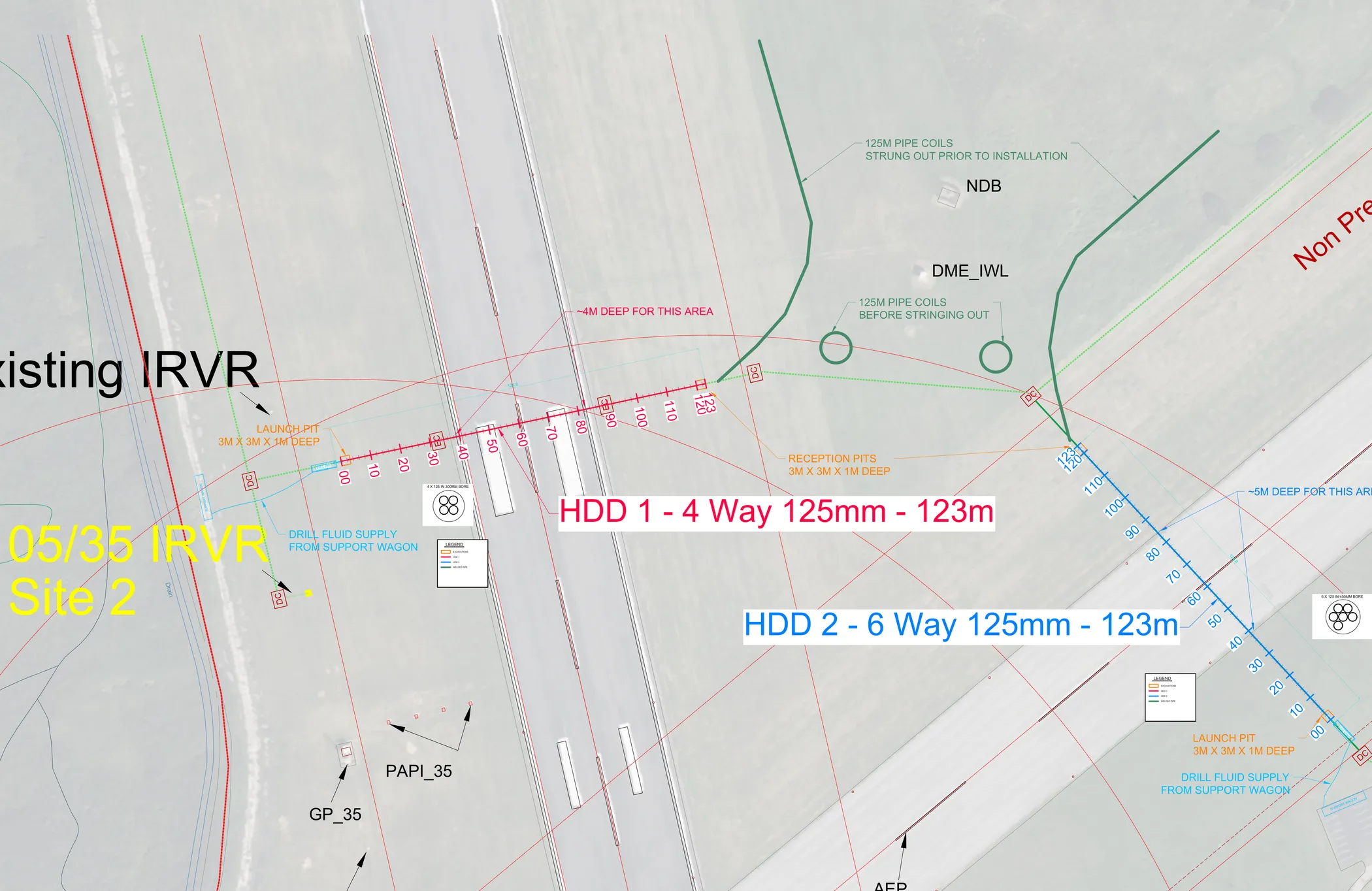
At Walney Aerodrome on the Cumbrian coast we designed and drilled two duct crossings straight under the live runways for BAE Systems, with MSF as principal contractor. Both bores, a four-way and a six-way 125mm duct bundle, were set out and drawn in-house before a single rod went in the ground, threaded clear of the runway lighting and navigation equipment.

S.W. Directional Drilling layout drawing for two duct crossings beneath the runways at Walney Aerodrome, showing the four-way HDD 1 and six-way HDD 2 bore lines, launch and reception pits, set out over an aerial of the airfield
Our layout drawing for the two Walney crossings. HDD 1 (a four-way 125mm bundle) and HDD 2 (a six-way 125mm bundle), each drilled 123m beneath a live runway from a launch pit to a reception pit, with the pipe strung out in coils ready to pull in.

Selected projects

Airport crossings we've drilled

A focused selection. Airport work brings together our under-road, under-rail and duct-installation capability on operational ground, planned around the airport's own safety regime.

Heathrow Airport

Birse / Mott MacDonald

12 installations · 4 × 180mm · 70–250m each

Twelve four-way duct installations, 70 to 250m long, drilled at Heathrow for the cable and service routes around the airport, keeping the duct runs below operational ground. We worked for Birse and Mott MacDonald.

Walney Aerodrome, Cumbria

MSF / BAE Systems · 2025

2 runway crossings · 4-way & 6-way 125mm · 123m each

Two duct crossings drilled beneath the live runways at Walney Aerodrome on the Cumbrian coast: a 123m four-way bundle of 125mm SDR11 duct across Runway 35, and a 123m six-way bundle across Runway 05, keeping the aerodrome in use. We worked for MSF as principal contractor, with BAE Systems the client.

Newcastle Airport

BCE Northern · 2023

4-way 180mm · ~30m · cable ducts under the perimeter

A four-way bundle of 180mm SDR11 duct drilled around 30m to take cables from outside the airport perimeter fence through to the inside, crossing the secure boundary without disturbing it. We worked for BCE Northern.

Teesside Airport

Arrowbuild · 2020

110m · 110mm SDR11 drainage

A 110m run of 110mm SDR11 drainage installed trenchlessly at Teesside Airport, on our home patch in the North East.

Southend Airport rail terminal

Birse Rail

180mm drainage · ~42m · across live Network Rail track

A 180mm drainage crossing drilled across live Network Rail tracks at the new airport rail terminal, through sand, gravel and clay, and completed inside a single nightshift.

Questions answered

Questions about airport installations

Can you work at an airport without disrupting operations?

Yes. Drilling installs the service from a pit clear of the operational area and steers the bore beneath it, so taxiways, aprons, access roads and rail terminals stay in use. Where the work touches a live railway or a sensitive zone we plan it into possessions and nightshifts and work to the airport's safety and permit regime. At Southend we crossed live Network Rail track at the airport rail terminal in a single nightshift.

What can you install at an airport?

Drainage, power and HV cable ducts, comms and signalling ducts, and water mains, the same range we install anywhere, drilled or rammed beneath the surface. At Heathrow we put in twelve four-way duct runs of 70 to 250m for the service routes around the airport.

Can you cross runways, taxiways, access roads and rail at an airport?

Yes. An airport is a mix of runway, taxiway, hardstanding, carriageway and sometimes rail, all of which we cross routinely, designed to the relevant settlement and asset-protection standards. At Walney Aerodrome we drilled duct crossings beneath two live runways. The bore is set deep enough below the surface and kept tight to the design line so movement at the surface stays within limits.

Do you handle the approvals and safety planning?

We design and draw the crossing in-house, produce the settlement and loading calculations, and work to the airport and any Network Rail approval requirements before the drilling starts. Tell us the constraints early and we will build the programme and the permits around them.

Can you work on secure and airside sites?

Yes. Over the years our crews have worked on plenty of secure ground, airfields, nuclear, rail and MOD sites among them, and have held BPSS and DBS clearance where a job has called for it. We are used to the vetting, the escorting and the access controls that come with secure sites and have never had a problem meeting them. Tell us the clearance and access requirements early and we will make sure the crew and the paperwork are in order before we come to site.

Got an installation at an airport?

Send us the drawings and the operational constraints. We'll plan the crossing around the airport's safety and permit regime and give you a budget price.