Est. 2005 · UK-wide trenchless installations07920 553 578·enquiries@swdirectionaldrilling.co.uk
Trenchless Services · Featured
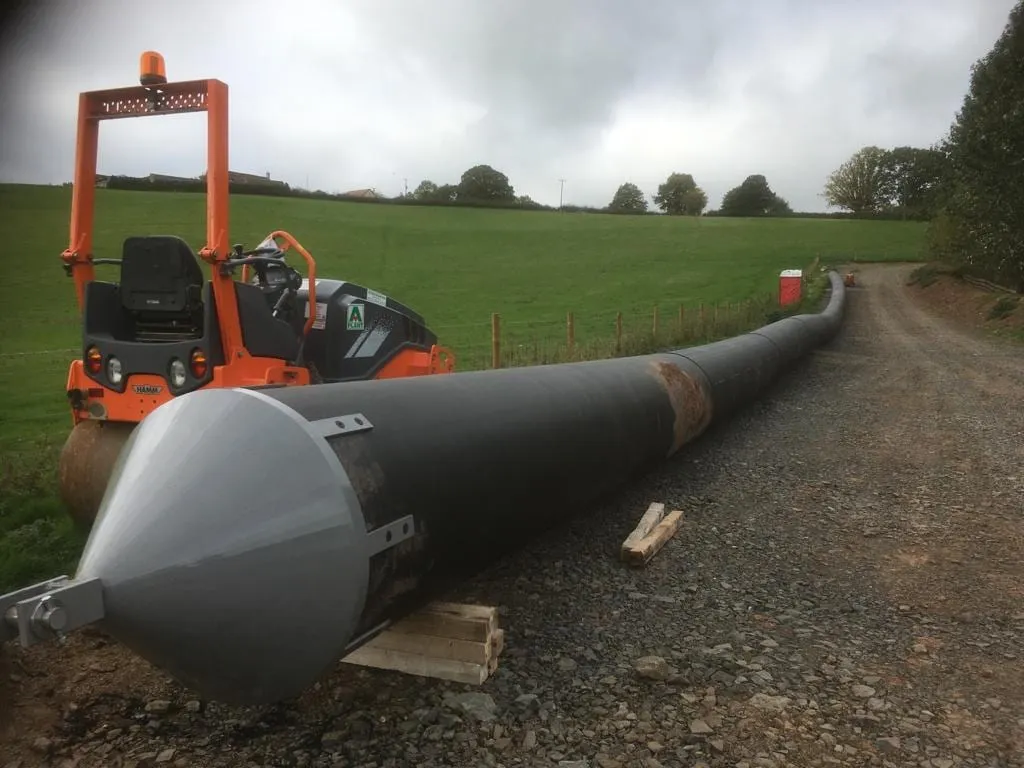
Large-diameter gravity drainage and outfalls, up to 900mm, drilled to falls under survey control. The same crossing a tunnel or pipe jack would do, often for a fraction of the cost.
Drainage is where trenchless directional drilling really proves its worth. Deep, large-diameter gravity drains and outfalls are exactly the jobs where an open trench becomes eye-wateringly expensive, and where many contractors assume the only options are pipe jacking or tunnelling. Often, they're wrong.
We drill gravity drainage to falls. The bore is steered to a designed gradient under survey control, so the finished pipe holds its grade across the whole crossing. That lets us install surface-water and foul drainage, outfalls and sewers up to 900mm without a trench, and frequently for far less than the alternatives.
Capability at a glance
| Pipe diameter | Up to 900mm |
|---|---|
| Flow type | Gravity drainage drilled to falls, and pumped/rising mains |
| Grade control | Survey-controlled bore profile held to design gradient |
| Installs | Surface-water & foul outfalls, sewers, culvert connections, land drainage |
| Ground | Clay, sand, gravel, made ground & rock |
| Why it wins | Often far cheaper than tunnelling or jacking on suitable jobs |
| Coverage | UK-wide · established 2005 |
Gravity work depends on accurate levels in and a controlled as-built out. Both are central to how we deliver.
How it works
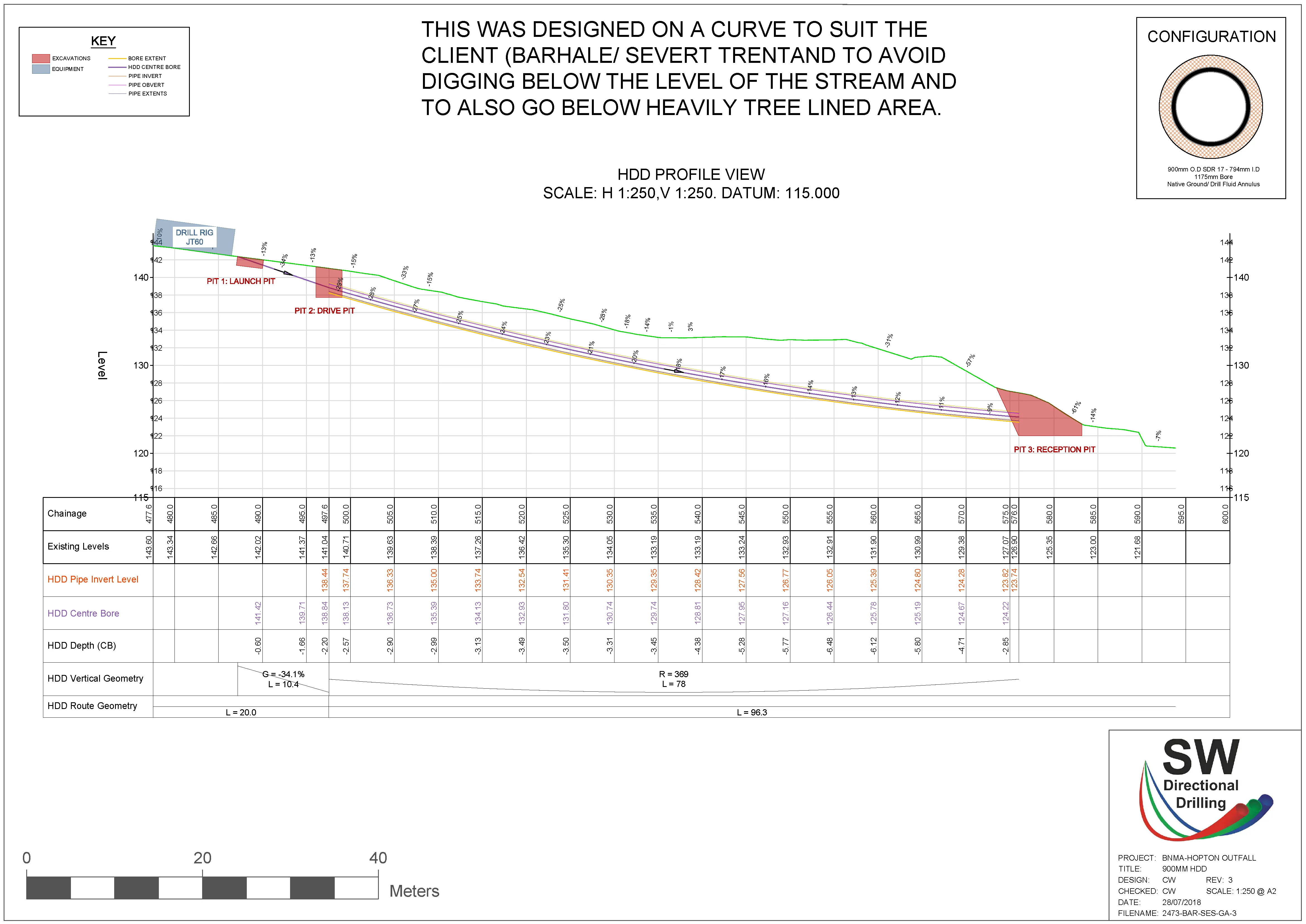
A drilled drain uses three pits. The launch pit is where the drill goes in, the drive pit is where the pipe starts at its invert level, and the reception pit is where the pipe run finishes.
Because all the curve happens in the set-back, the whole pipe run between the drive and reception pits sits on the design grade, with no bends in it to hold water.
The drive and reception pits are about the size you would dig anyway to install the manholes, typically 2m by 2m and dug down to 0.3m below the invert. On deeper jobs the reception pit can need a slip trench off the back of it so we can pull the pipe in, because the pipe has to bend down from the surface to reach the bore.
The differentiator
Anyone can pull a pressure pipe through a bore that undulates, because the water doesn't care. Gravity drainage is unforgiving. Get the gradient wrong and it silts up or backs up. Holding a designed fall across a long, deep bore is the hard part, and it's the part we've built our drainage reputation on.
It starts at the design stage, in-house. We model the bore as a profile with the required fall, set out from accurate site levels, then steer and survey the pilot bore to that profile. The result is drainage laid to grade, trenchlessly.
The deeper and larger the drain, the bigger the gap between drilling and tunnelling. On one 900mm scheme, advising directional drilling over tunnelling saved the client about £1 million and finished in around three weeks. The Hopton 900mm outfall case study tells the full story. We'll always tell you honestly where drilling substitutes for jacking or tunnelling, and where it doesn't.
Questions answered
Yes, and it is one of the things we specialise in. Gravity drainage has to run to falls, meaning a continuous designed gradient, which is harder than installing a pressure pipe that can undulate. We steer the bore to a survey-controlled profile so the finished pipe holds its grade, letting us install drainage and outfalls trenchlessly where a trench would be too deep, too disruptive or too expensive.
Up to 900mm diameter, covering most surface-water and foul drainage, outfalls and sewers. For larger diameters or man-entry sizes, micro tunnelling may be needed. But a great many "it'll have to be jacked" jobs can in fact be directional drilled for far less.
The rig is set back from the drive pit so the bore can be drilled down from the surface to meet the start invert level there. From the drive pit onwards we drill at the required grade and line, monitoring the grade continuously and checking the position at every 3m rod, so the pipe is laid to the designed gradient rather than left to follow the ground. Accurate levels in and a proper as-built out are central to how we deliver drainage to falls.
On suitable jobs, directional drilling avoids the deep launch and reception shafts, the large compounds and the slow progress that tunnelling and pipe jacking require. On one 900mm gravity drainage scheme we advised drilling instead of tunnelling and saved the client around £1 million, finishing in roughly three weeks. It does not suit every job, but where it fits the saving is substantial.
Yes. We use rock-specific directional drilling tooling to take drainage and outfalls through weathered and solid rock, holding the gradient the same way as in soft ground. See our rock directional drilling service for detail.
Related services
Send us your levels and drainage design and we'll tell you whether we can drill it to falls, and how the cost compares to jacking or tunnelling.