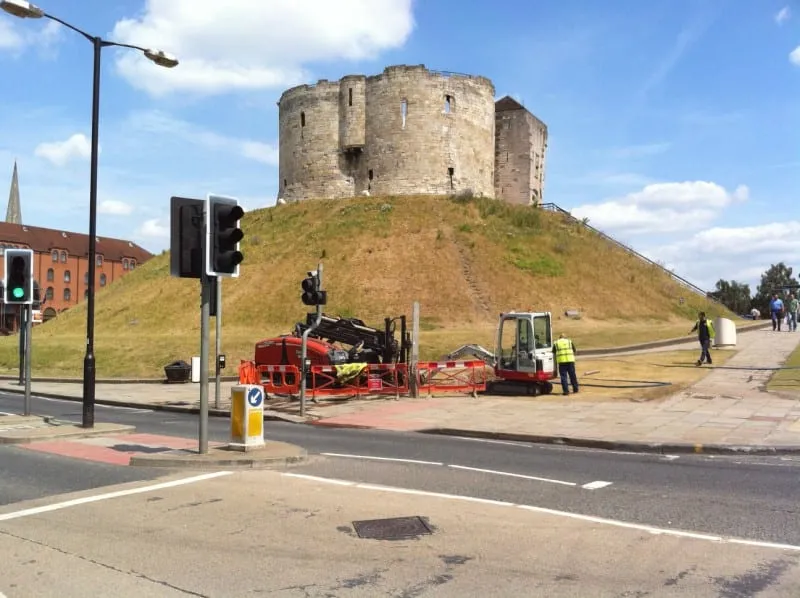
What does "trenchless" mean?
Trenchless simply means putting a pipe in the ground without digging an open trench along its whole length. Rather than excavating the entire route, the pipe is bored or driven underground from a small pit at each end, so the surface in between, whether that is a river or canal, a railway, a busy road, buildings, trees or a finished driveway, is left undisturbed.
It is sometimes called no-dig installation. The pay-off is less disruption, less reinstatement, and a safe way to cross things you are not allowed to dig up. There is also far less risk of striking an existing buried service, because the bore follows one controlled, surveyed line rather than opening up a long trench across everything in the ground. On the right job it also works out cheaper overall, even though the kit on site is more specialist than a digger and a gang.
Trenchless versus digging a trench (open-cut)
Open-cut is the traditional way, dig a trench the full length of the route, lay the pipe, backfill and reinstate. It is fine in an open field with nothing in the way. It becomes slow, costly and disruptive the moment a road, railway, river or buildings sit on the line, because you then have to close, dig, support, backfill and resurface all of it.
Trenchless turns that into two small pits and a single bore underground. The road stays open, the river is untouched, and there is far less to reinstate afterwards. That is why for crossings, deep installs and anything sensitive, trenchless is usually both cheaper overall and far less hassle. We will still tell you honestly when a straight dig is the better answer.