Est. 2005 · UK-wide trenchless installations07920 553 578·enquiries@swdirectionaldrilling.co.uk
Trenchless Services
Trenchless installation of large steel casings, driven through coarse, cobbly and mixed ground that steered methods can't handle, with minimal settlement under roads and railways.
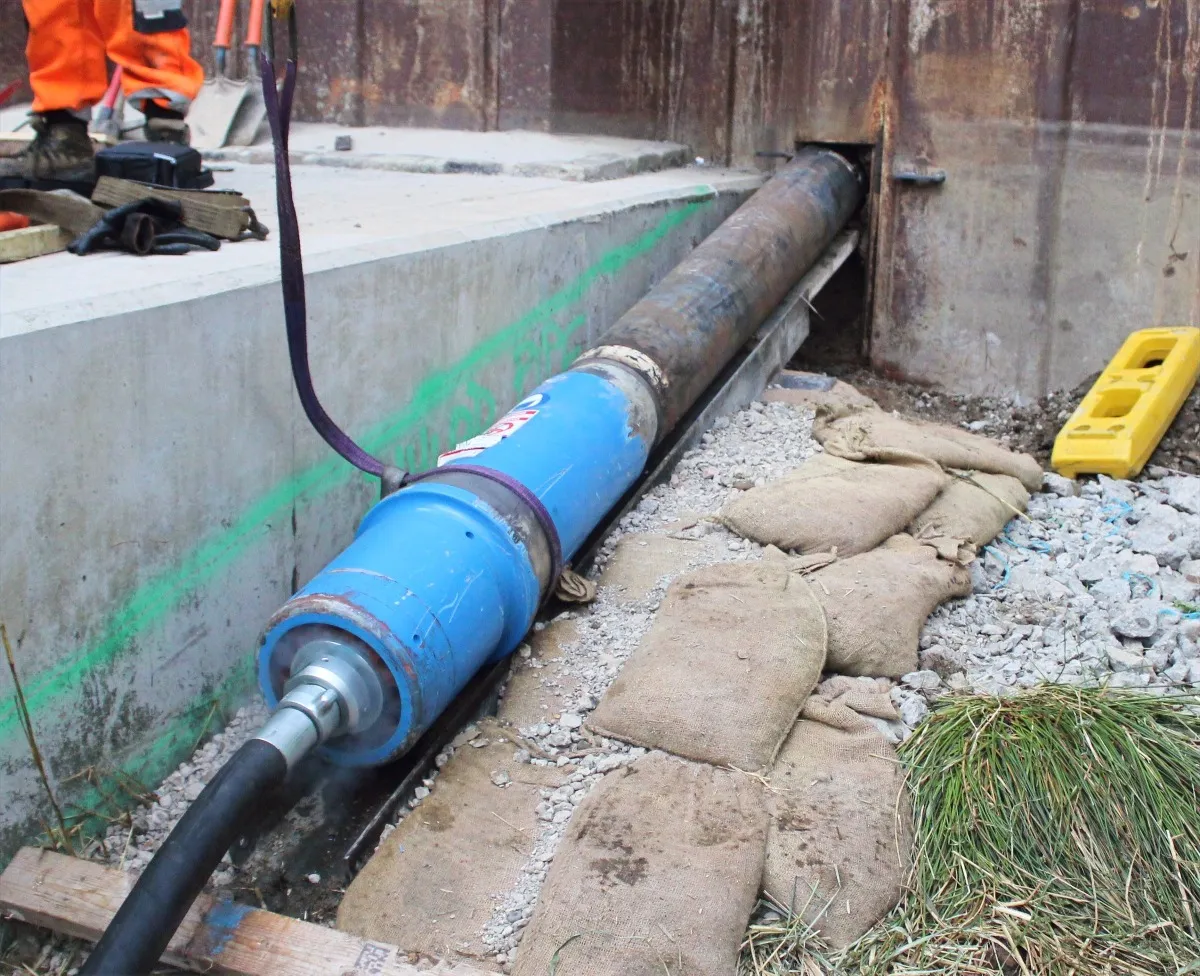
Pipe ramming drives an open-ended steel casing through the ground with a pneumatic hammer. It is the method of choice where the ground is too coarse, mixed or unstable to steer a bore, and where a large-diameter casing has to go under a road or railway with as little disturbance as possible.
Because the casing is hammered straight through and the spoil core is cleared afterwards, ramming is fast, forgiving of cobbles and gravel, and causes very little surface movement. That makes it a go-to for Network Rail embankments and highways crossings, and a reliable fallback when a directional bore would risk a frac-out.
Capability at a glance
| Casing diameter | Up to 1400mm |
|---|---|
| Typical drive length | Up to ~80m (ground dependent) |
| Casing material | Steel, open or closed face |
| Best ground | Granular, cobbly, gravelly & mixed fill that defeats steering |
| Ground movement | Minimal heave or settlement, suits rail & road embankments |
| Use | Carrier-pipe casings, road/rail crossings, jacking-pit avoidance |
| Coverage | UK-wide · established 2005 |
Drive length depends heavily on diameter and ground. We confirm it on a per-job basis.
The method
Questions answered
Pipe ramming is a trenchless technique that uses a powerful pneumatic hammer to drive an open-ended steel casing horizontally through the ground. The soil core inside the casing is removed afterwards by auger, water jet or compressed air. Because the casing is driven rather than steered, it is fast, robust and well suited to coarse, mixed or unstable ground where directional drilling would struggle.
Ramming wins in granular, cobbly or gravelly ground, under high rail and road embankments, and where you need a large-diameter steel casing in a relatively short, straight drive. It causes very little ground movement, so it is often specified under live railways and carriageways. Directional drilling is better for longer, deeper, steered crossings and for plastic pipe. We will tell you honestly which one fits your job.
We install steel casings up to around 1400mm diameter. Drive lengths are typically up to about 80m depending on diameter and ground, after which the friction and core weight make other methods more economic.
Very little. The casing displaces and compacts the ground around it rather than over-excavating, so surface heave and settlement are minimal. That is one of the main reasons Network Rail and highways crossings often call for a rammed casing.
Yes. The steel casing usually acts as a sleeve, and the carrier pipe (water, gas, drainage or cable ducts) is then installed inside it on skids or spacers. This protects the service and allows future replacement without re-excavation.
Related services
Pit-launched casing crossings, with an honest look at when drilling does it for less.
View service →For longer, deeper, steered crossings and plastic-pipe pulls.
View service →When the obstacle is rock rather than coarse fill.
View service →Send us the diameter, length and ground conditions and we'll confirm whether ramming is the right method, then price it.