Est. 2005 · UK-wide trenchless installations07920 553 578·enquiries@swdirectionaldrilling.co.uk
Explainer
Directional drilling is not one single thing. The same basic idea, steering a bore underground and pulling a pipe back through it, scales from a small service duct under a drive to a large pipeline under a river, and changes again depending on the ground and what the pipe is for. This guide breaks the main types down in plain English so you can see where your job fits.
By rig size
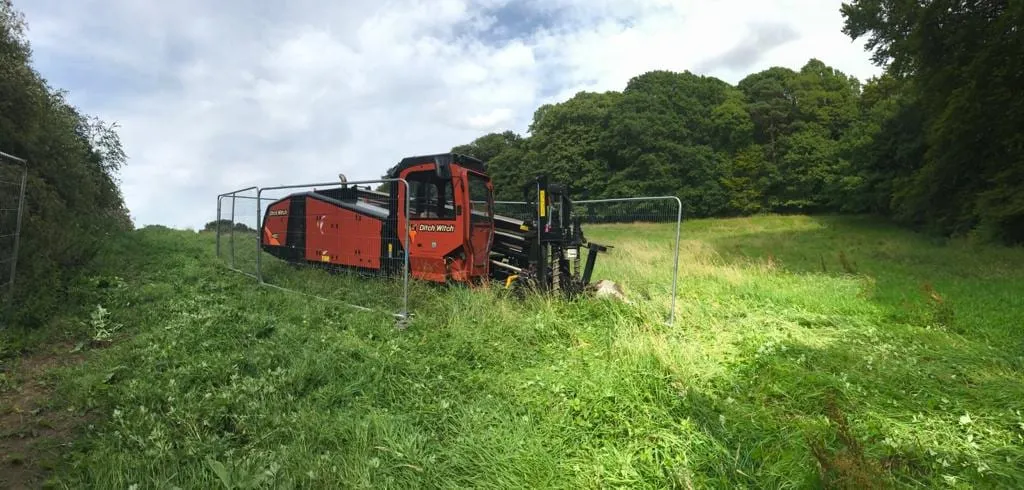
The most common way to describe directional drilling is by the class of rig, which sets how big and how long a crossing it can install. Rigs are graded by their pullback capacity, the force the machine can pull the product pipe back through the bore with. It is often quoted in pounds, as a lot of the machinery is American, so the figures below give kilograms-force and kilonewtons alongside for easy comparison. The industry splits it roughly three ways, sometimes called small, medium and large rather than mini, midi and maxi. We run Ditch Witch rigs, so the examples in each class below are Ditch Witch models.
| Mini HDD | Under 40,000 lb of pullback (about 18,000 kgf, or 180 kN). The smallest and most common class, for short crossings and small-diameter service ducts, the bulk of everyday utility work under roads. A Ditch Witch example is the AT32 All Terrain, at around 30,000 lb. |
|---|---|
| Midi HDD | Around 40,000 to 100,000 lb of pullback (roughly 18,000 to 45,000 kgf, or 180 to 450 kN). More power and reach for larger pipes and longer crossings, up to a few hundred metres, such as mains and multi-duct routes. A Ditch Witch example is the JT60, at around 60,000 lb. |
| Maxi HDD | From 100,000 lb of pullback upward (about 45,000 kgf, or 450 kN), with the largest rigs beyond 1,000,000 lb (around 450,000 kgf, or 4,500 kN). The heavy class for large-diameter product pipe and long single shots like river crossings and trunk pipelines. A Ditch Witch example is the JT120, at around 120,000 lb. |
A general guide to the classes. The right rig for your job comes from the pipe size, the crossing length and the ground, so tell us those and we'll match it.
By ground
The ground decides the tooling. In soils, clay, sand, silt and gravel, standard directional drilling cuts and steers the bore with a jetting or fluid-assisted head. In hard ground, sandstone, limestone and other rock, that head cannot make progress, so the bore is driven by a dedicated rock system instead, such as a Ditch Witch All Terrain dual-pipe rig that turns the rock bit mechanically and uses far less drilling fluid than a mud motor.
It is the same steered method either way, but rock directional drilling takes longer and costs more because rock is slow and hard on tooling. Knowing whether there is rock on the line, from ground investigation or local knowledge, is one of the biggest things that shapes both the method and the price.
What the pipe is for changes how the bore has to be drilled:
A few trenchless methods get lumped in with directional drilling because they also install a pipe without a trench, but they work differently. Impact moling fires an unguided mole through soft soil over short distances. Auger boring jacks a cased bore forward from a pit. Both have their place, and we can advise on or arrange them, but where a crossing needs steering, distance or accuracy, directional drilling is the method that delivers it. For a full comparison of the no-dig options, see our plain-English guide to trenchless methods.
Questions answered
Directional drilling is usually split three ways. By rig size, into mini, midi and maxi HDD, which scales the method from small service ducts up to large pipelines. By ground, into standard directional drilling for soils and rock directional drilling for hard ground that needs specialist tooling. And by purpose, from pressure pipe and utility ducts that only need to get from A to B, through to gravity drainage that has to be drilled to an exact fall. Most jobs are described by a combination, for example a mini HDD utility crossing in clay.
It is mainly the size and pulling power of the rig, and therefore the size and length of crossing it can install. Mini HDD covers short, small-diameter service work, which is the bulk of everyday utility installation. Midi HDD handles larger pipes over longer distances. Maxi HDD is the heavy class used for large-diameter product pipe and long crossings such as rivers. The right class for your job comes from the pipe size, the length and the ground.
Not strictly. Impact moling fires an unguided pneumatic mole through soft soil and cannot be steered, whereas directional drilling uses a steerable, survey-tracked drill head. People often group them together because both install a pipe without a trench, but moling is its own short-run method. Where a crossing needs steering, distance or accuracy beyond a short service run, that is directional drilling territory.
You do not need to pick the class yourself. Tell us the pipe size, the length of the crossing, the location and what you know about the ground, and we will match it to the right rig and method, whether that is a small mini HDD service shot, a midi crossing of a road, a rock bore through sandstone, or a gravity drainage run drilled to falls. We will also tell you honestly if a different method or a straight dig suits the job better.
Related
The core steered method, in full, across all sizes of crossing.
View service →Directional drilling fitted out to steer a bore through hard rock.
View service →Gravity drainage drilled to an exact fall, without a deep trench.
View service →Send us the pipe size, the length, the location and anything you know about the ground, and we'll tell you which type of directional drilling suits it and what it should cost.