
Est. 2005 · UK-wide trenchless installations07920 553 578·enquiries@swdirectionaldrilling.co.uk
Case Study · Grid Connection
At National Grid's Iron Acton substation, we delivered the grid connection for a new battery energy storage (BESS) site. We designed the cable route and drilled its two trenchless crossings. One slipped the HV ducts under the site's only access road; the other ran under a protected hedge and into the live substation, with no road closure and no trench through the hedge.
The job
A new battery energy storage system (BESS) site at Iron Acton needed its high-voltage cables run into the grid. We were brought in by principal contractor HVGS (High Voltage Grid Services) to deliver the grid connection, and that meant more than just drilling. We designed the cable route, including its two trenchless crossings, and installed the ducts the 33kV cables are later pulled through.
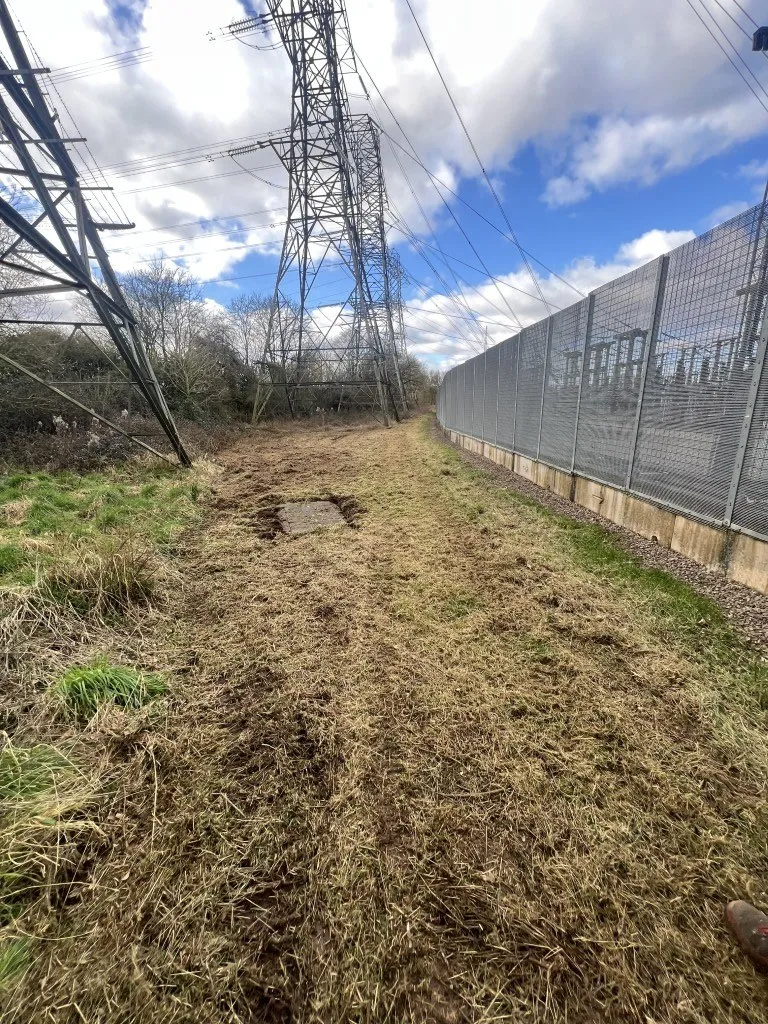
It is exactly the kind of route open-cut struggles with. It had to cross the site's only access road and a hedge with a tree-protection plan over it, then arrive inside a live National Grid substation ringed with security fencing. Trenching it would have meant closing the access road and digging through a protected hedge.
So we drilled it. Two crossings, one under the hedge and one under the road, each carrying the same bundle of HV ducts several metres down into the live substation, leaving the access road open and the hedge standing.
Project at a glance
| Worked for | HVGS (High Voltage Grid Services), principal contractor |
|---|---|
| Site | A battery energy storage system (BESS) site, client side Omnia / Pelagic / National Grid |
| Location | Iron Acton, South Gloucestershire (BS37 9TX), a live National Grid substation site |
| Scope | The grid connection: we designed the cable route and drilled the two trenchless crossings carrying the HV duct bundle into the substation |
| Ducts | 3 × 180mm + 2 × 110mm HDPE (SDR 11). Supplied, butt-fusion welded and de-beaded, drilled in as one bundle |
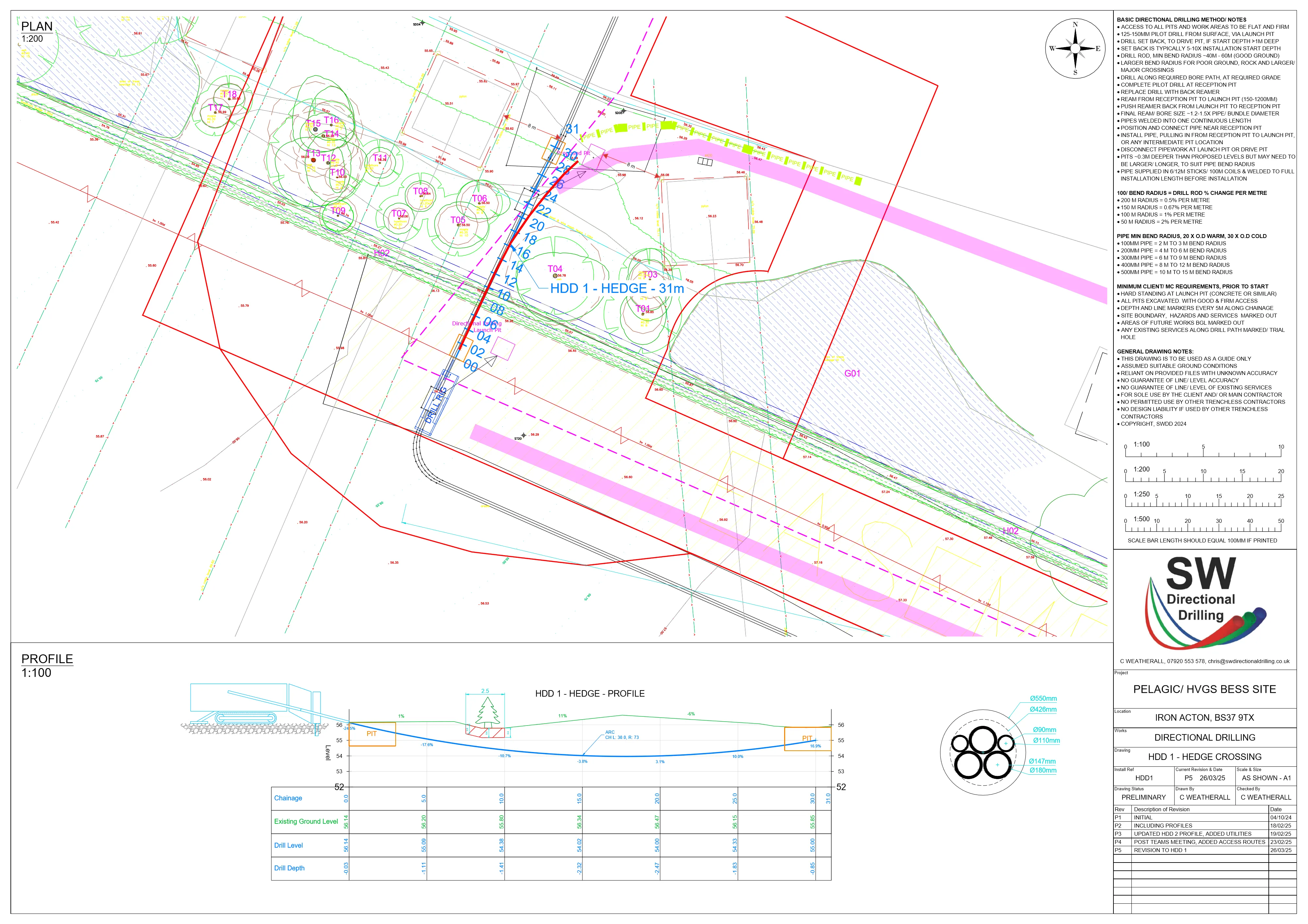
| HDD 1 - Hedge | 31m under a tree-protected hedge, on a curved bore into the live substation |
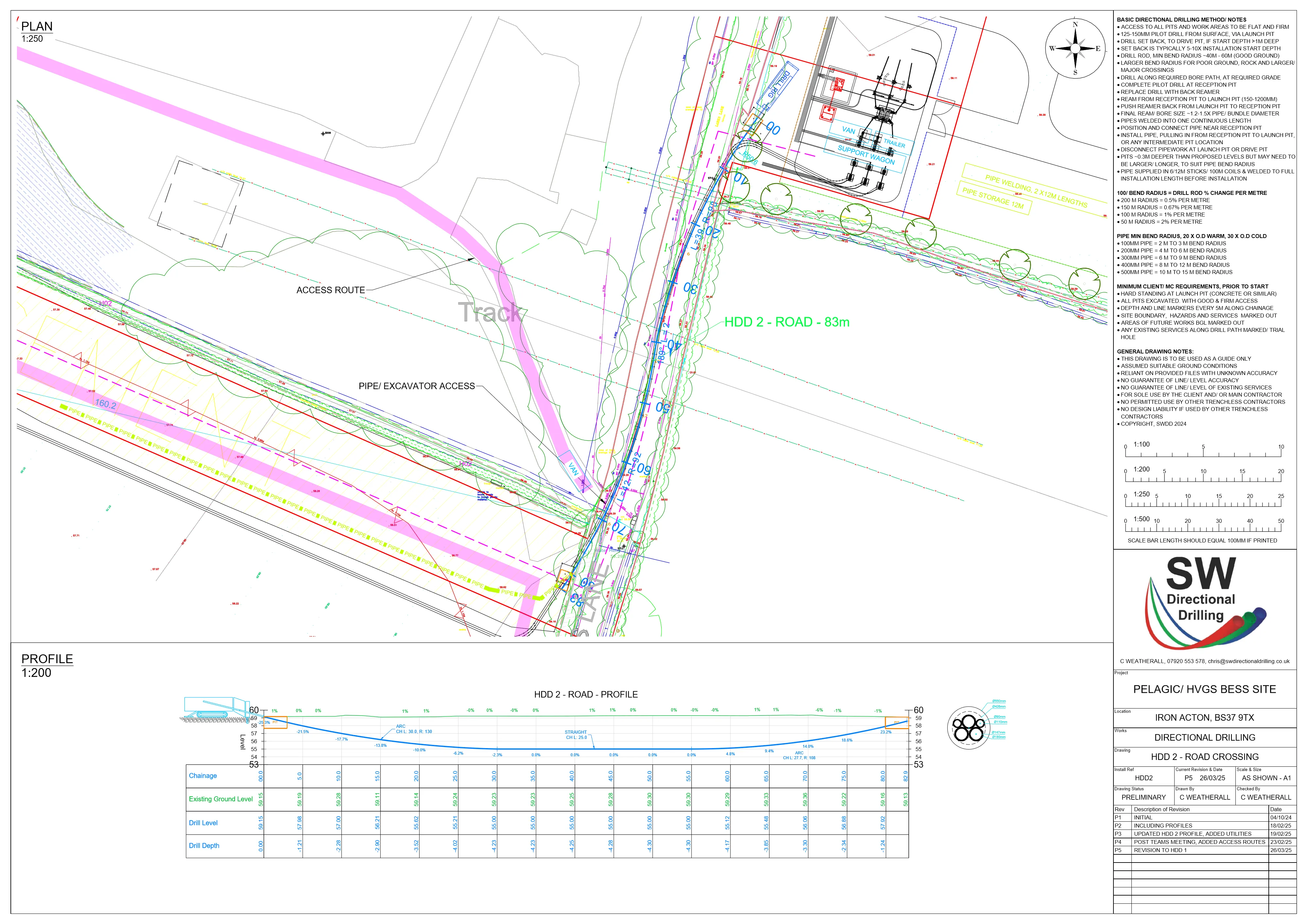
| HDD 2 - Road | 83m under the site's only access road (local-authority lane) |
| Bore | Reamed to ~550mm; launch & reception pits; ducts entered the substation through a cored hole in the compound concrete base |
| Groundworks | We excavated the launch and reception pits and managed the drilling spoil and arisings ourselves |
| Ground | Cohesive clay over mudstone. The deeper part of the bore was in rock |
| Engineering | Designed, drawn & settlement-assessed in-house; predicted ground settlement well inside the National Highways <10mm tolerance |
| Outcome | Both crossings completed and the HV ducts installed ready for cabling. No road closure, no trenching through the hedgerow |
| Year | 2025 |
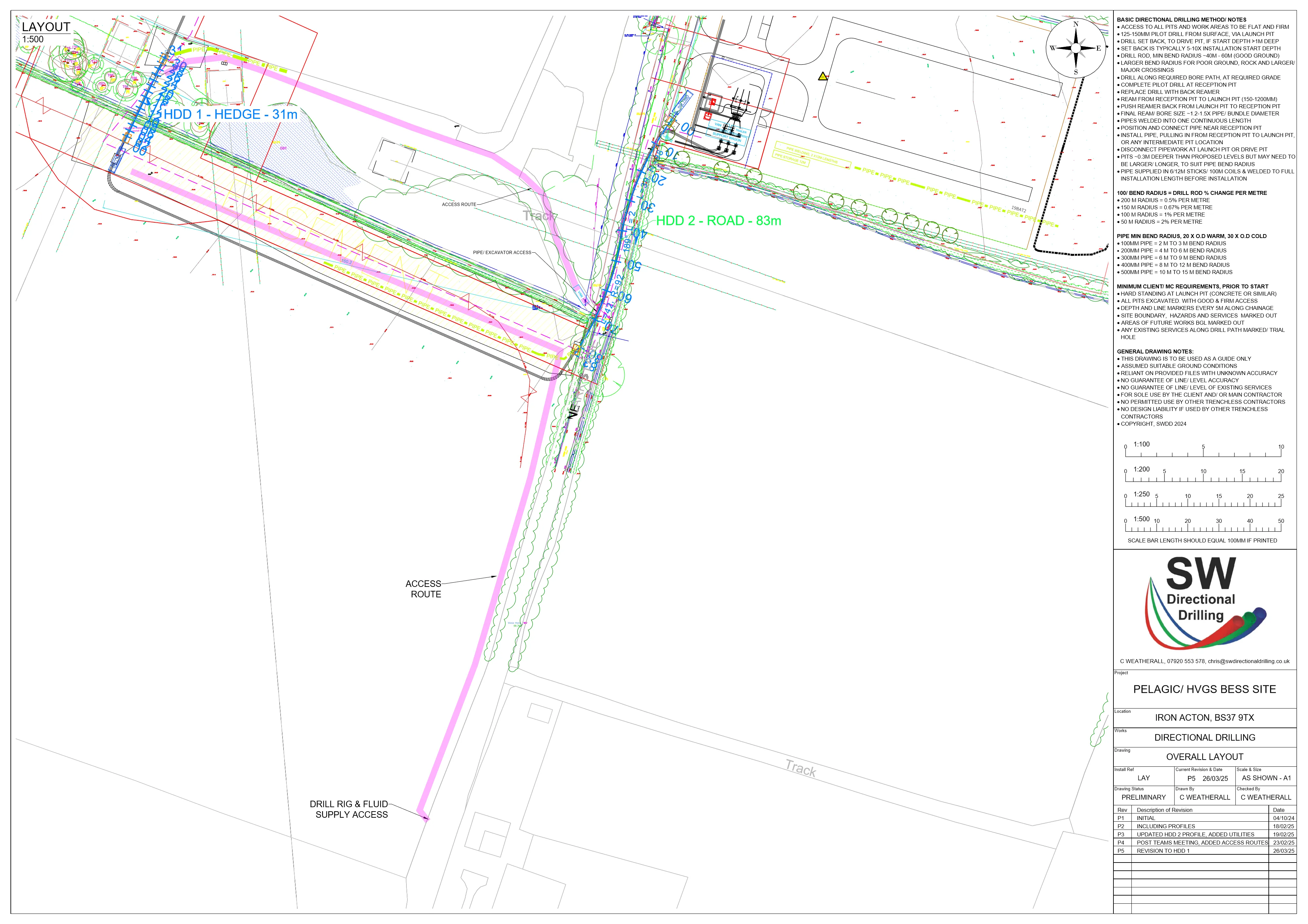
Our REV P5 general arrangement, designed and checked in-house.
See it for yourself
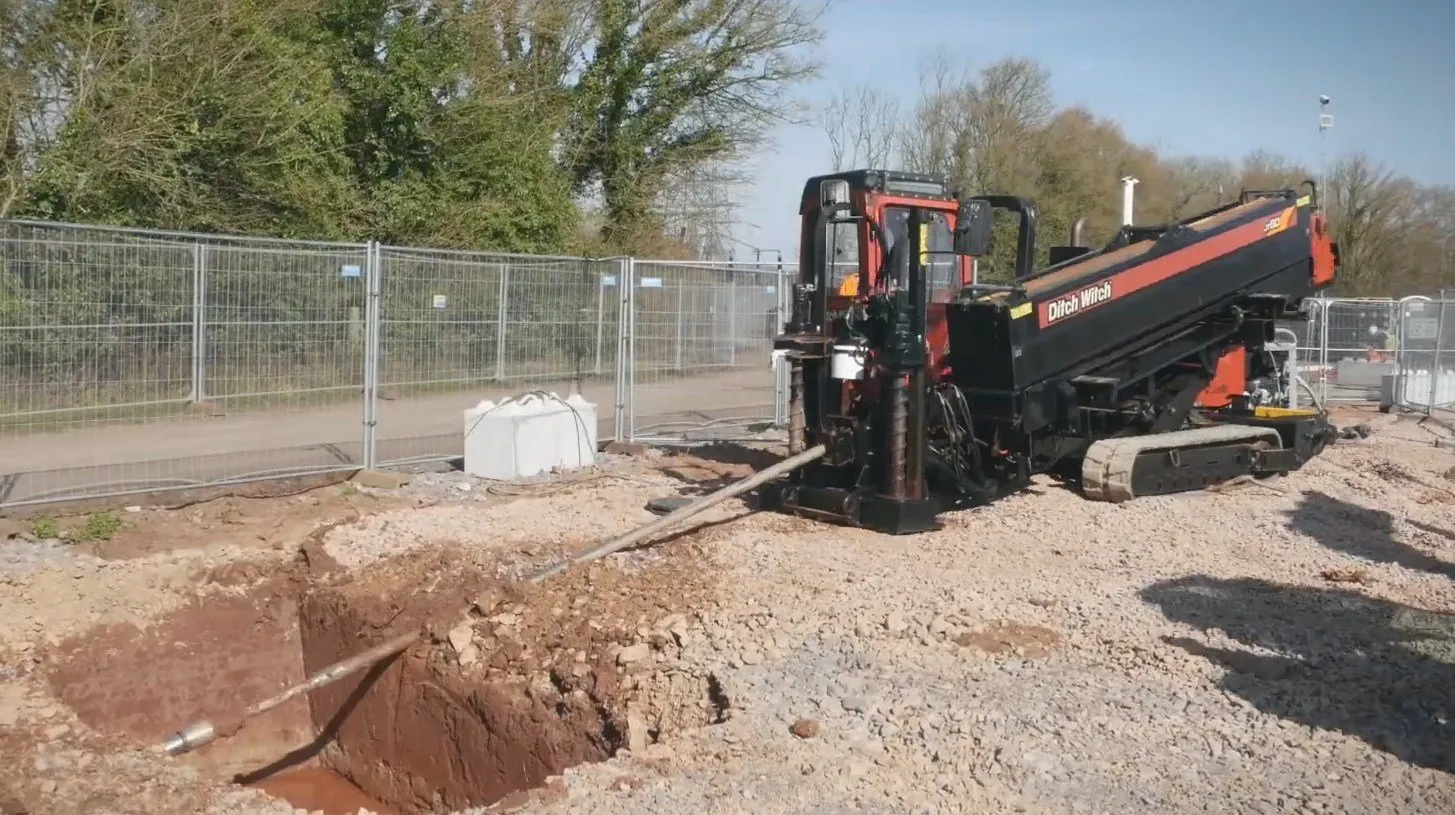
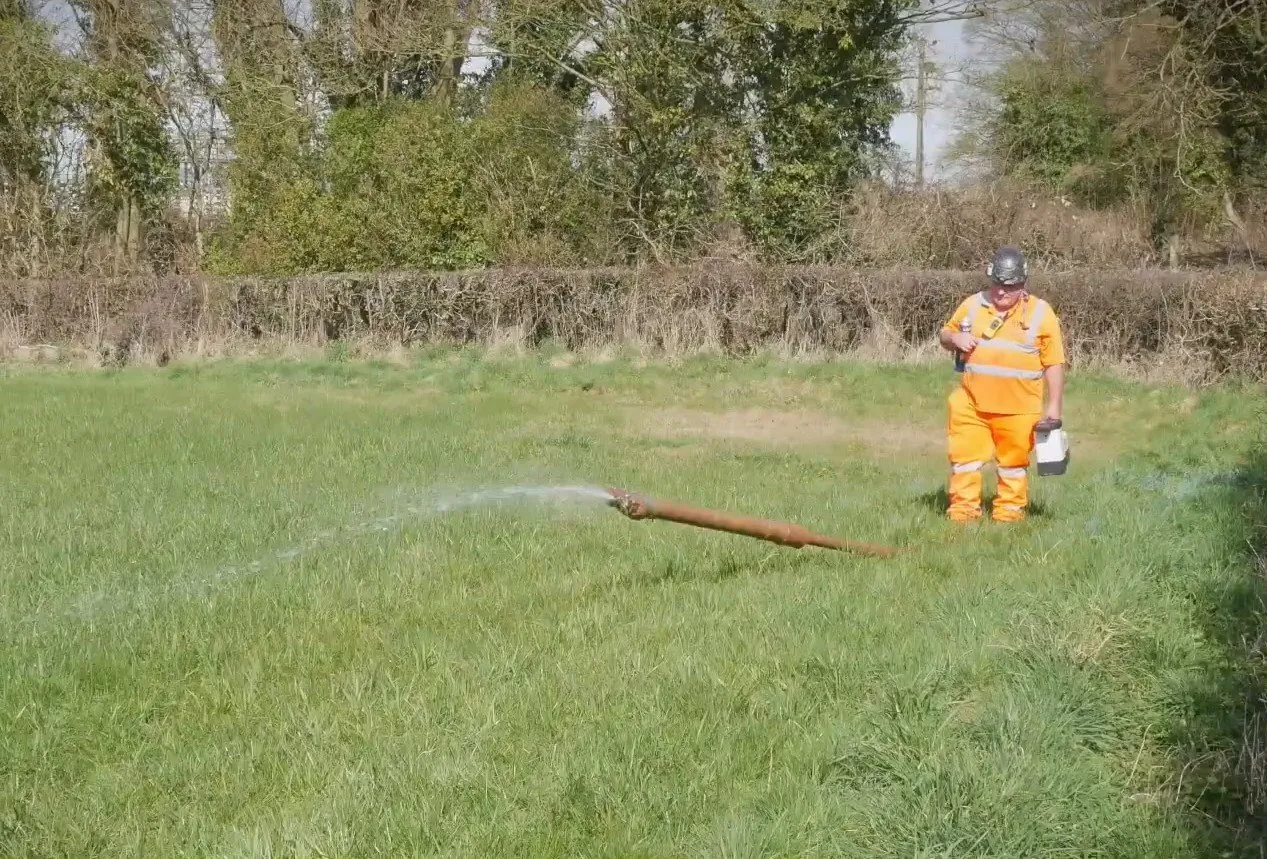
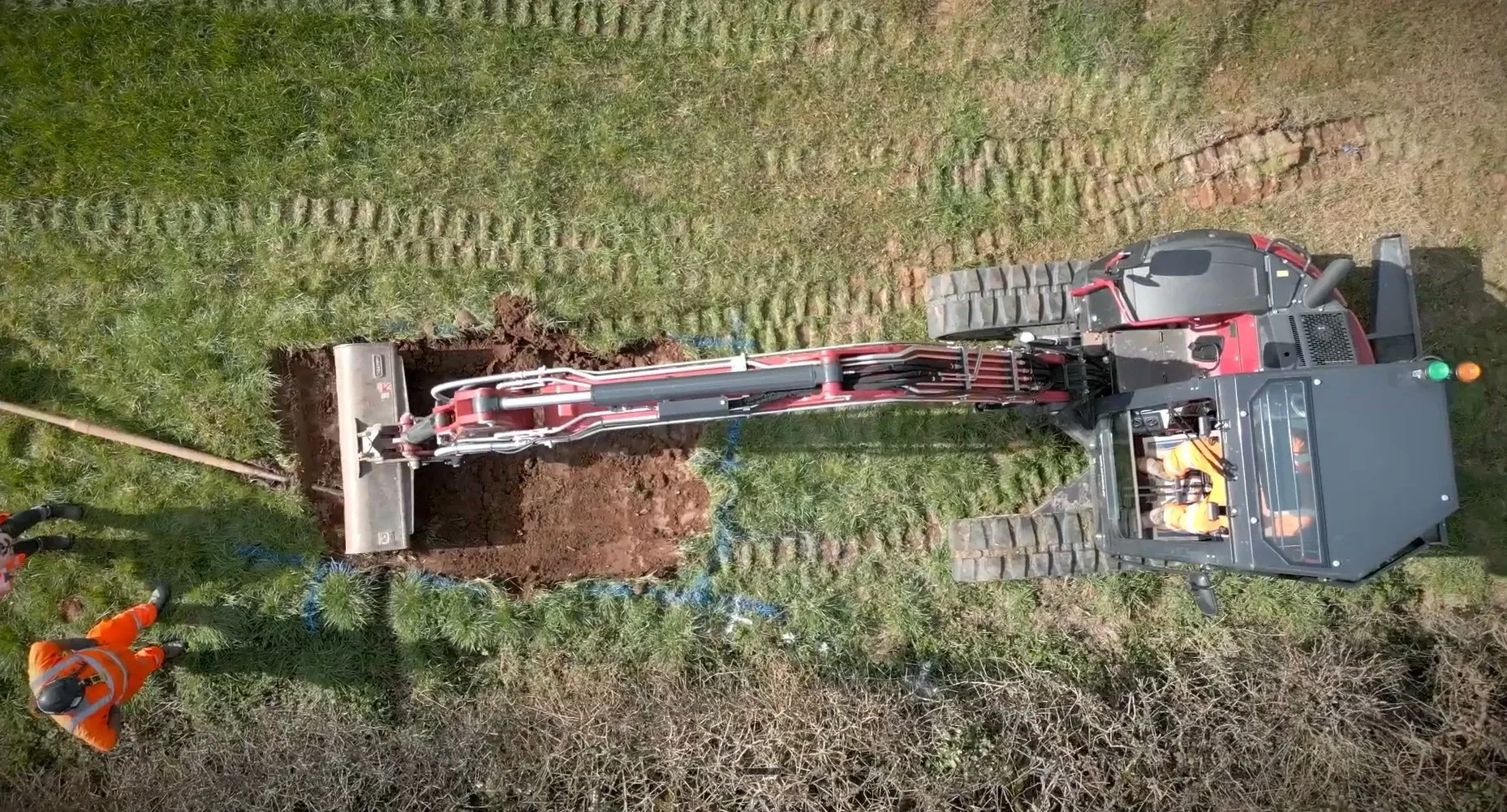
A short film from site. The rig, the pits and the ducts going in. It's a job we're proud of, and one the main contractor and the client side were delighted with from design right through to installation. All of it was drilled through clay and into mudstone. It shows directional drilling doing exactly what it's good at. Installing services cleanly under an obstruction, with barely a footprint left behind.
The crossings
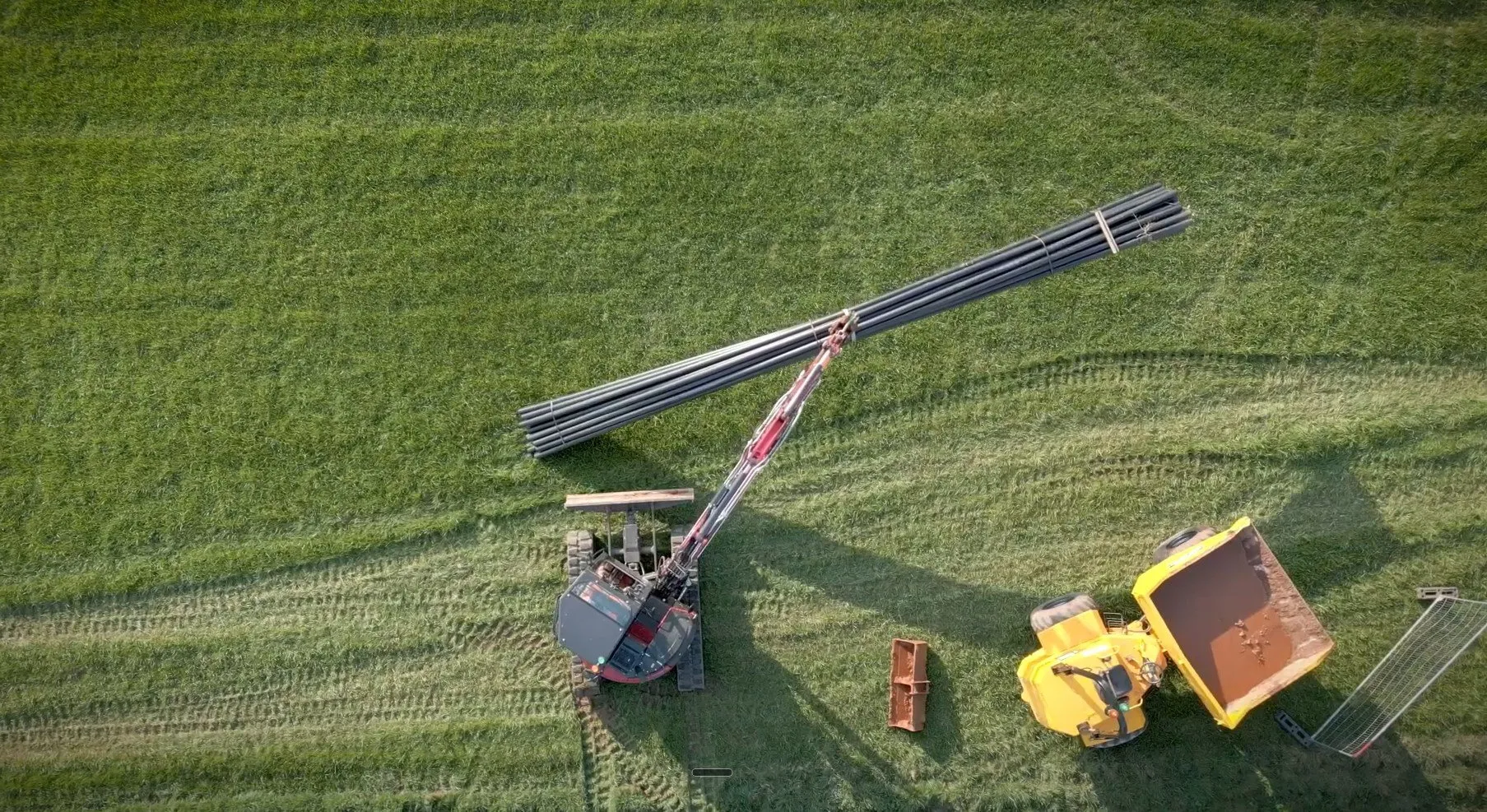
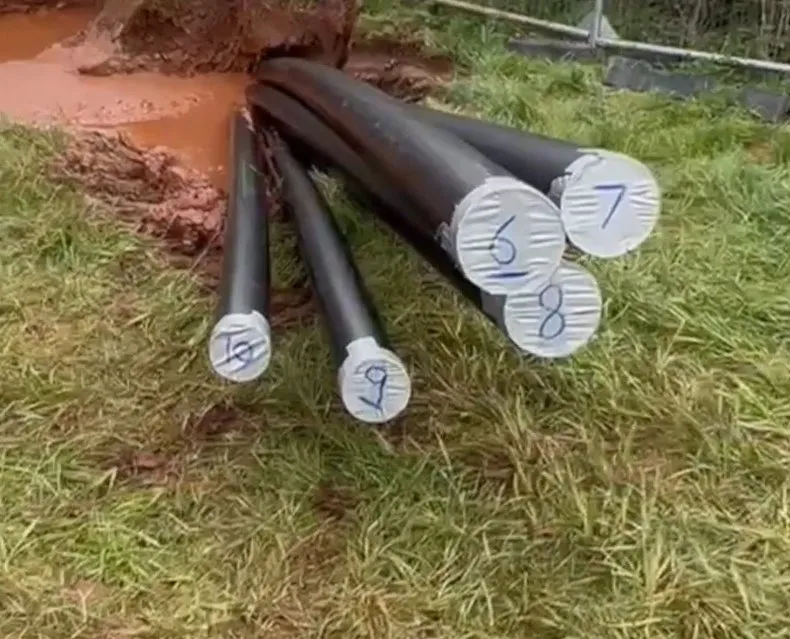
Both crossings installed the same product. A bundle of three 180mm and two 110mm HDPE ducts (SDR 11), pulled in together through a bore reamed to around 550mm. The ducts give the cabling team clean, continuous routes to pull the 33kV grid-connection cables through later.
We supplied the ducts, butt-fusion welded them into continuous lengths and de-beaded them, taking the internal weld bead back out of each joint so the cables pull through cleanly with nothing to snag on. It is a standard part of how we hand a duct route over ready to cable.
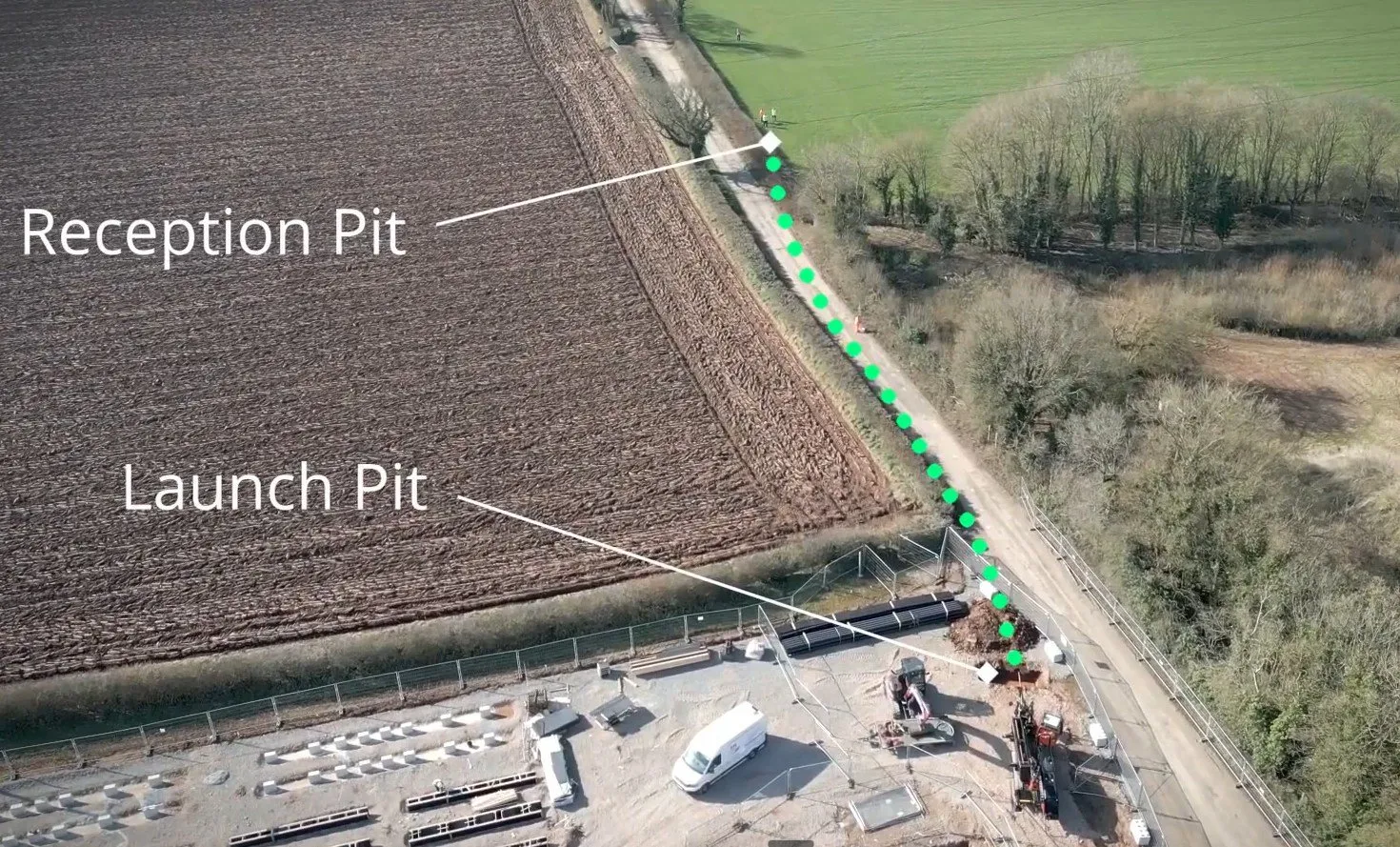
HDD 1, the hedge crossing, ran about 31 metres on a curved bore to thread under the protected hedge and into the live substation. HDD 2, the road crossing, ran about 83 metres under the site's only access road, set out with a launch and a reception pit. At the substation, the ducts entered through a cored hole in the compound's concrete base, the kind of detail that has to be designed in, not improvised.
The groundwork was ours as well. We excavated the launch and reception pits for both crossings and managed the drilling spoil and arisings throughout, so the job came as a complete package, from designing the route to leaving the ducts in the ground ready to cable, rather than just the bore.
We designed, drew and checked the whole thing in-house, and the drawings were approved by all the stakeholders (the main contractor, the client side and National Grid) before we broke ground. The drawings below are our own general-arrangement sheets for the two crossings.
On site
The engineering
Drilling next to a substation and under a road means you have to know the ground is not going to move. Before we started we produced a settlement assessment in-house, using the established Peck / O'Reilly & New method, for the full duct bundle in the cohesive clay (the shallower ground), with the deeper part of the bore running into mudstone.
The prediction for the completed installation came out at a credible worst case of about 4.5mm of ground movement, comfortably inside the National Highways tolerance of less than 10mm we'd set as the criterion for the road. And that figure is a conservative ceiling, not a forecast. Drilled with the right technique, a crossing almost never reaches its predicted maximum. In practice we've never had one settle to its predicted sMax, and most of the time the surface movement is effectively nil. Knowing the worst case up front is what lets a client and a contractor sign a crossing off with confidence, rather than hoping it holds.
That assessment, the general-arrangement drawings, the RAMS and the inspection and test plans all came from us. One team carried the crossing from design through to the ducts being in the ground.
The outcome
Two clean directional-drilled crossings delivered the cable ducts for the grid connection on a live National Grid site, under a road that stayed open and a protected hedgerow left intact, with the ground movement designed to stay inside tolerance. It's the kind of work that wins on a tight, sensitive site precisely because it barely leaves a mark.
Questions answered
Yes. At Iron Acton we directional-drilled in the high-voltage cable ducts for a battery-storage (BESS) grid connection. A bundle of three 180mm and two 110mm HDPE ducts carrying the 33kV cables, which we supply, butt-fusion weld and de-bead ready for cabling. Over the years we have installed cable ducts right across the range, from LV, through HV (11kV and 33kV) and EHV (66kV and 132kV), up to the 275kV and 400kV transmission network. Drilling installs the ducts in long, continuous lengths under whatever is in the way, so the cabling team can pull their cables straight through afterwards. See our horizontal directional drilling service for how it works.
The line crossed a local-authority lane into the substation and a protected hedgerow. Open-cut would have meant closing the road and trenching straight through a hedge that had a tree-protection plan over it. Directional drilling slips the duct bundle underneath both, several metres down, with a small pit each side, so the lane stayed open and the hedgerow was left intact.
We assess it before we drill. For Iron Acton we produced a settlement assessment in-house (Peck / O’Reilly & New method) for the duct bundle in cohesive clay, and the predicted worst-case ground movement came out comfortably inside the National Highways tolerance of less than 10mm. That predicted maximum, the "sMax", is a deliberately conservative figure. With correct drilling and fluid-management techniques it is extremely rare to actually reach it. We have never had a crossing settle to its predicted sMax, and most of the time the surface movement is effectively nil. Designing the bore depth and ream size to keep settlement in tolerance is just a standard part of how we plan a crossing.
Yes. We delivered this for High Voltage Grid Services on a live National Grid substation site, working inside the security fence line and around live HV infrastructure, to the contractor’s and client’s requirements. Directional drilling suits this work because it keeps the dig footprint to a couple of small pits rather than open trenches across a sensitive site.
Related services
The steered method behind both Iron Acton crossings: ducts and pipes installed under roads, hedgerows and services.
View →Steering a bore through mudstone and rock with dedicated tooling, as in the deeper part of this crossing.
View →How crossings like these are priced, and what moves the number.
View →Send us your drawings and levels. If it can be directional drilled, under a road, a hedgerow or live infrastructure, we'll tell you honestly, with the settlement designed in.