Skip to content
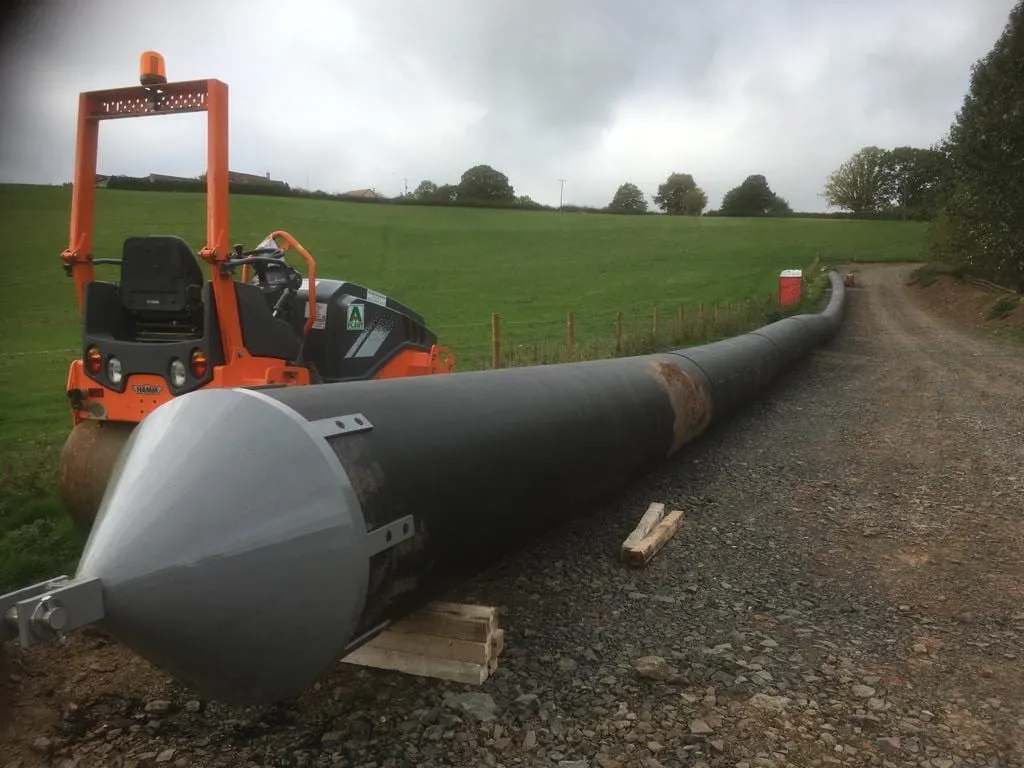
A large-diameter HDPE pipe string with its pulling head fitted, laid out ready to be pulled into the bore

Crossing Solutions

Large-diameter directional drilling

Water mains, sewers, outfalls and culverts drilled in and pulled through in one length, under roads, rivers and whatever else is in the way. Up to 900mm, and often far cheaper than a deep open cut, a pipe jack or a tunnel.

  • Up to 900mm
  • Water mains & sewers
  • Butt-fused in one string
  • UK-wide since 2005

A large pipe is where trenchless pays off most. The bigger and deeper the pipe, the more an open cut costs and the more ground it disturbs, and the alternative people usually reach for is a pipe jack or a tunnel, with deep shafts at each end. Directional drilling puts the same pipe in from a pit on each side, in one length, with nothing dug in between.

Water mains, sewers and outfalls

Most of our large-diameter work is water. Trunk and distribution mains under rivers and roads, sewers and rising mains, outfalls, and culverts. A pressure main does not mind a gentle curve in the bore, so it suits drilling well. A gravity sewer or outfall has to hold its fall the whole way, and we drill those to grade as well, the way we did the 900mm outfall at Hopton. The step-by-step for a drain is on our trenchless drainage page.

Can it be drilled, or does it need jacking?

Plenty of large pipes that get priced as a pipe jack or a tunnel can be drilled instead. Drilling suits pressure mains, outfalls and drains to falls up to 900mm, and it usually costs a lot less because there are no deep shafts and no jacking pipe to buy. On the Hopton outfall, drilling instead of tunnelling saved the client about £1 million.

Jacking still earns its place. On bigger, man-entry sizes, and on long gravity sewers that need very tight line and level below the water table, pipe jacking or micro tunnelling is the right tool, and we will say so. Send us the job and we will tell you which side of the line it falls.
What we install

DiameterUp to 900mm
What goes inWater and trunk mains, sewers and rising mains, outfalls, culverts and drainage
PipeHDPE / PE100, butt-fused on site into one string. Steel where the job needs it
WeldingOur own butt-fusion welders, with de-beading where a clear bore is needed
RigsOur own drilling fleet, with access to larger rigs when a crossing calls for one
GroundClay, sand, gravel and rock. The Hopton 900mm outfall went through strong rock

We set the bore size, length and pipe for each crossing in the design.

How it goes in

How a large pipe is drilled in

  1. Drill the pilot bore. A small steered pilot bore is drilled along the design line from the launch pit to the reception pit, the same as any crossing.
  2. Ream it out in stages. A large hole is opened out in several passes with bigger reamers each time, rather than in one go. The finished bore is larger than the pipe, typically up to one and a half times its diameter, so the drilling fluid and cuttings can get out and the pipe can follow the curve. At Hopton the 900mm pipe went into a bore reamed to 1175mm.
  3. Weld up the string. While the bore is being reamed, the pipe is butt-fused into one continuous string on the far side, laid out in line with the bore.
  4. Pull it back in one length. The string is connected behind the last reamer and the rig pulls it back through the bore in one go, so there are no joints in the crossing.

Two things matter more on a big pipe than a small one. The first is the pull. For drilling, the wall thickness is often set by the force of pulling the pipe in rather than by the working pressure, so we check the pull for each crossing and pick the pipe to suit. The second is that a large empty pipe wants to float in the drilling fluid, which adds to the pull and loads the pipe against the top of the bore. We plan for both in the design, before anything goes on site.

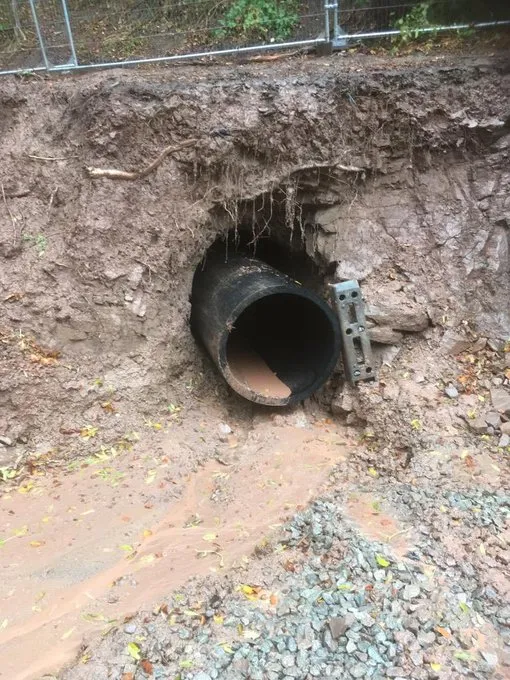
The end of a 900mm HDPE drainage outfall installed by directional drilling
The 900mm outfall at Hopton, drilled to falls through rock.

Selected projects

Some of the large-diameter work we've done

A few examples of the water mains, outfalls and culverts we have drilled in.

Hopton 900mm drainage outfall

Barhale / Severn Trent

900mm · drilled to falls through rock · reamed to 1175mm

A 900mm gravity outfall drilled to falls through strong rock on a curved bore, reamed out to 1175mm and pulled in as one string. Drilling it instead of tunnelling saved the client about £1 million.

Read the case study →

Angelinos Trunk Main river crossings

Murphy / Thames Water

710mm · 7 crossings · ~100-120m each

Seven river crossings of 710mm trunk main, welded into single strings on the bank and pulled through under the watercourse, delivered over about two months. We worked for Murphy as principal contractor, with Thames Water the client.

Mulgrave Estates lake drain

Mulgrave Estates

710mm & 630mm culverts · 6,000,000-litre lake

A collapsed culvert had dammed a valley into a lake holding six million litres of water. After a 180mm drain to drop the level, we installed 710mm and 630mm replacement culverts, draining the lake and taking away the flood risk.

Pawlett Hams water main

Parrett Drainage Board

252m · 355mm · under a tidal river

One of our longer drills. A 252m water main pulled in under the tidal River Parrett near Bridgwater, around 5m below the bed, to restore the supply to a grazing marsh.

Read the case study →

Cost

What large-diameter drilling costs

Large-diameter pipe over a long distance is the top end of drilling work, and on the biggest jobs it can run into the hundreds of thousands. The comparison that matters is with the alternative. Against a deep open cut, a pipe jack or a tunnel, drilling is very often the cheaper way to put the same pipe in. What moves the price, and real budget ranges, are in our cost guide.

Questions answered

Large-diameter drilling questions

How big a pipe can you install by directional drilling?

We install pipe up to 900mm by directional drilling, where the ground and the crossing suit it. Send us the pipe size, the length and the ground and we will tell you straight away whether it can be drilled.

Can a water main be installed by directional drilling?

Yes, and it is one of the most common large-diameter jobs we do. The main is butt-fused into one continuous string of PE pipe on site, then pulled back through the drilled bore in a single length, so there are no joints in the crossing itself. We have pulled trunk mains under rivers this way, including seven 710mm river crossings on the Angelinos trunk main for Thames Water.

Should a large pipe be drilled or pipe jacked?

It depends on the size and the job. Directional drilling suits pressure mains, outfalls and drains to falls up to 900mm, and it is usually much cheaper because there are no deep shafts and no jacking pipe. Pipe jacking or micro tunnelling earns its cost on bigger, man-entry sizes, and on long gravity sewers that need very tight line and level below the water table. We will tell you honestly which it is, and on our 900mm Hopton outfall drilling instead of tunnelling saved the client about £1 million.

How long can a large-diameter bore be?

It depends on the pipe size, the ground and the space to lay out the pipe string, so we set it for each crossing in the design. Our Pawlett Hams water main, at 252m under a tidal river, is one example of a longer drill, and we can go further where a job needs it. A long large-diameter pull also needs room on one side to weld up and lay out the whole pipe string before it goes in.

What pipe do you use for large-diameter drilling?

Mostly HDPE (PE100), which we weld into one string on site with our own butt-fusion welders. For drilling, the wall thickness is often set by the pull rather than the working pressure, so the pipe is commonly a thicker SDR than an open-cut lay would need, and a crack-resistant PE100-RC grade suits the rougher ride through a bore. We install steel where the job calls for it.

Got a large pipe to put in?

Send us the pipe size, the length, the route and anything you know about the ground. We'll tell you whether it can be drilled, how we'd do it, and give you a budget price.