Est. 2005 · UK-wide trenchless installations07920 553 578·enquiries@swdirectionaldrilling.co.uk
Case Study · Grid Connection
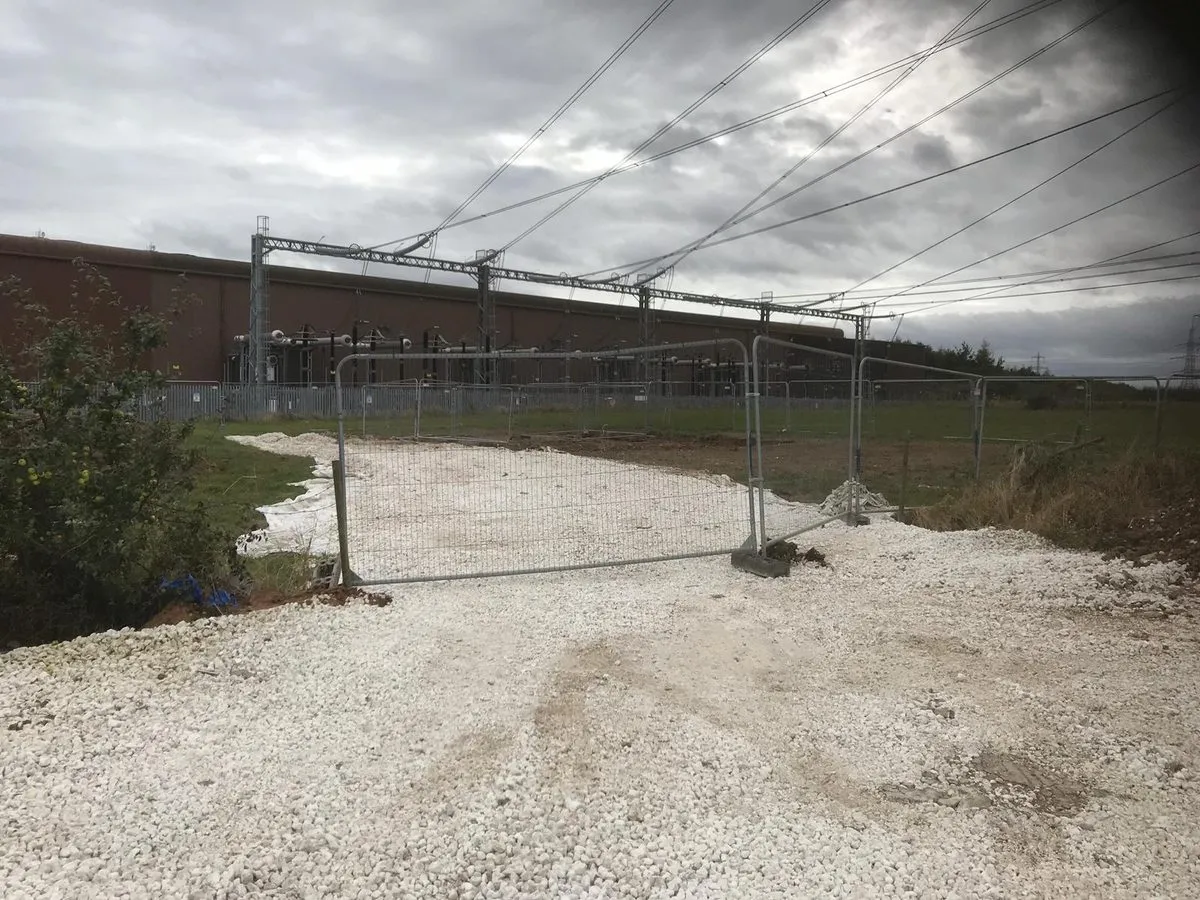
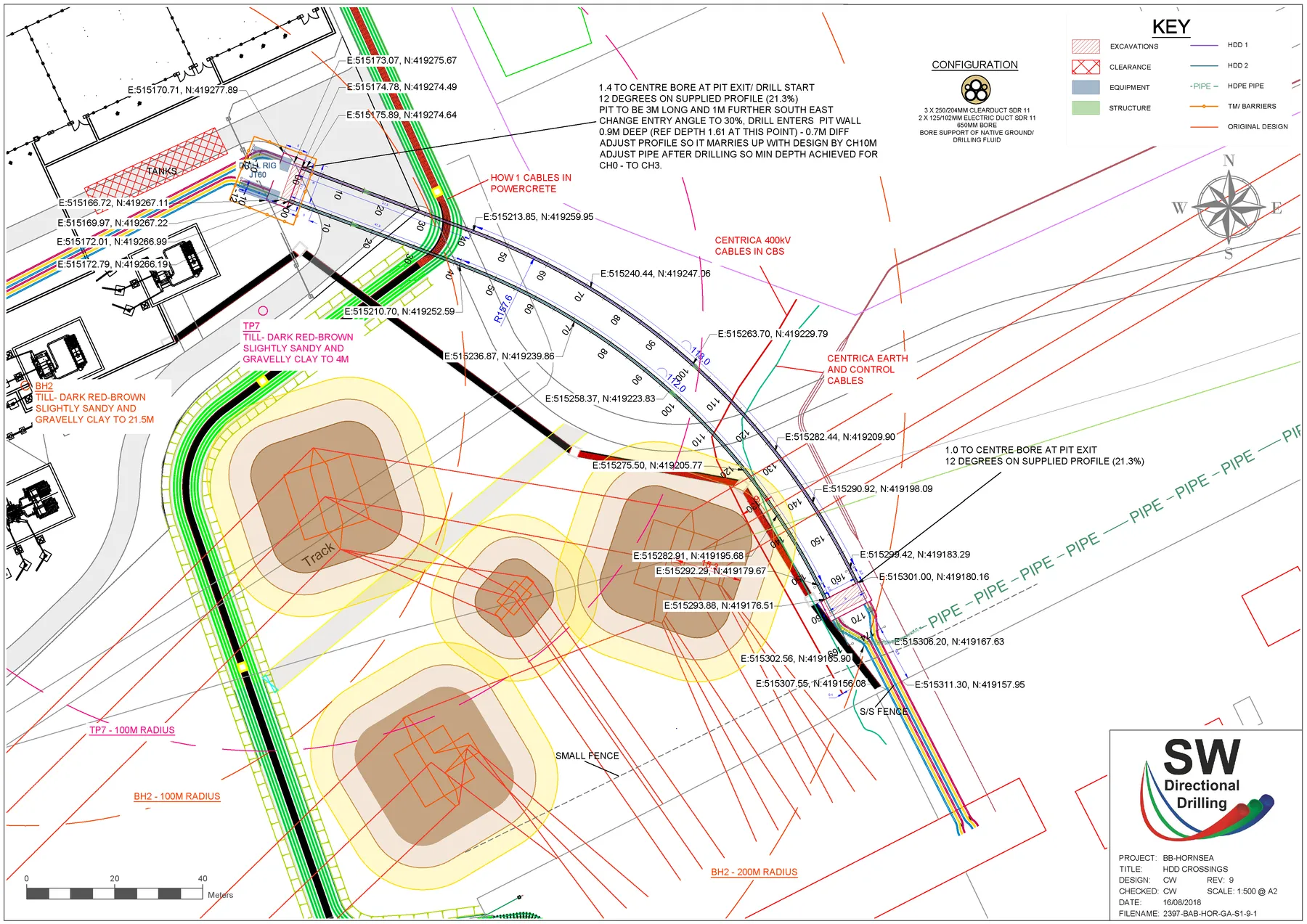
At Killingholme in North Lincolnshire we directional-drilled the cable-duct bores that carry the final 400kV grid connection for the Hornsea Two offshore wind farm, for Balfour Beatty and Ørsted. Two bores, one per circuit, steered across live 400kV cables and under the overhead lines into the new substation.
The job
Hornsea Two is one of the largest offshore wind farms in the world. The power it generates comes ashore on the Lincolnshire coast and has to be connected into the National Grid, and the last link in that chain is at Killingholme, where two 400kV circuits run into a new substation.
Those circuits needed their cable ducts installing, across a site already criss-crossed with live high-voltage infrastructure. Balfour Beatty and Ørsted brought us in to design and drill them. Trenching across live 400kV cables and under the overhead lines was never on, so we steered the duct bores in instead, threading a safe path between everything already in the ground and overhead.
We installed two bores, one for each circuit, and connected the new Hornsea 02 400kV substation to the grid.
Project at a glance
| Worked for | Balfour Beatty and Ørsted |
|---|---|
| Project | The final grid connection for the Hornsea Two offshore wind farm, which powers over a million homes |
| Location | Killingholme, near Immingham, North Lincolnshire |
| Connected to | The new Hornsea 02 400kV substation |
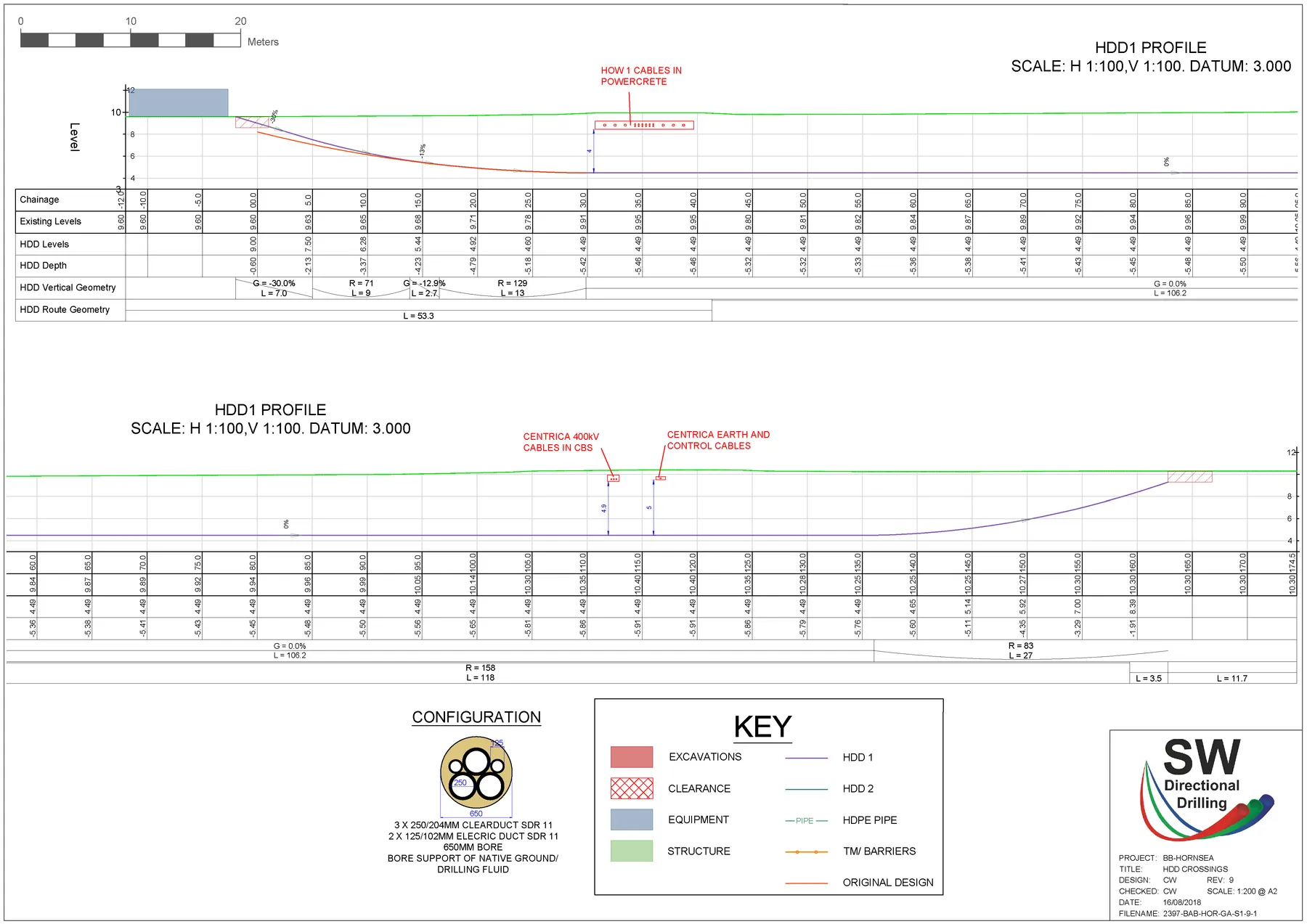
| Scope | Two directional-drilled bores, one for each 400kV circuit, about 8m apart |
| Length | Around 160 to 165m per bore |
| Bore | 650mm bores, kept deliberately tight to suit the cable thermal design |
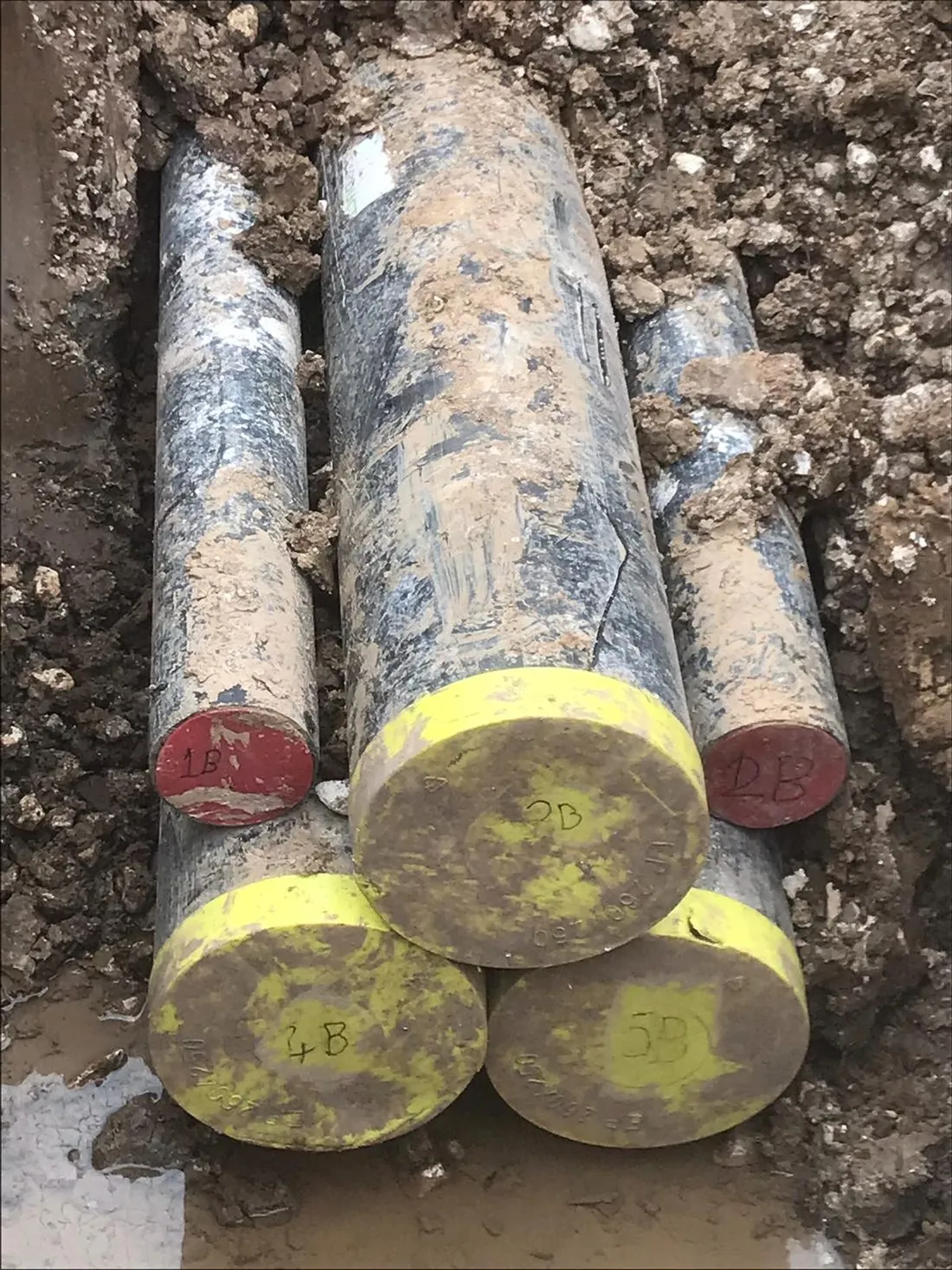
| Ducts | 3 × 250mm and 2 × 125mm SDR11 per bore, in Peak Pipes clear duct (black HDPE, ENATS 12-24 Class 1+, the highest HV duct spec), supplied and butt-fusion welded |
| Crossing | Steered across the live HOW1 and Centrica 400kV cables and beneath the overhead lines |
| Outcome | Both circuits drilled in cleanly, connecting Hornsea Two to the National Grid |
Designed and drawn in-house to the cable and grid requirements.
The crossing
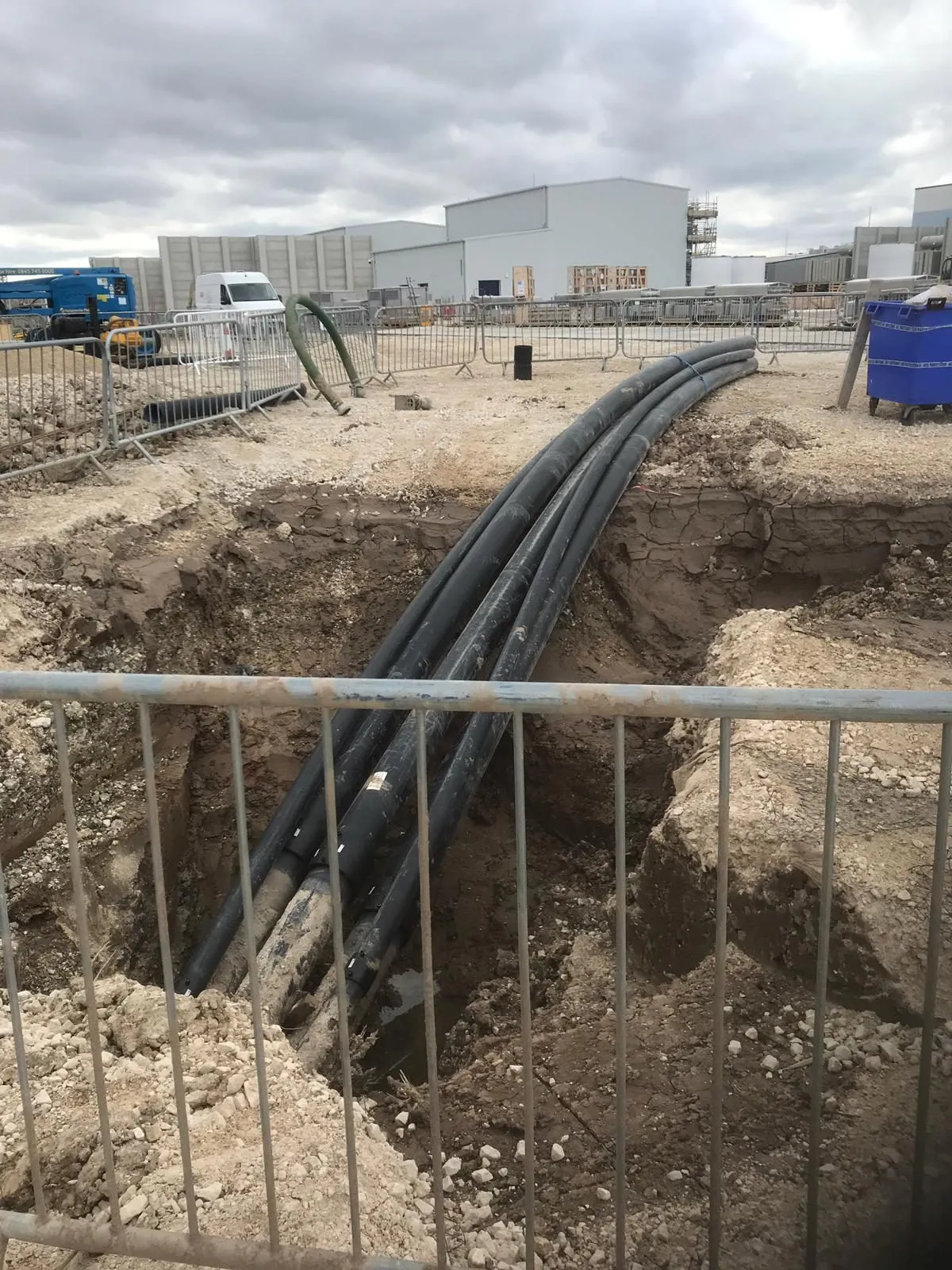
Each of the two circuits ran in its own bore, the pair set about 8 metres apart and each around 160 to 165 metres long. Every bore carried a bundle of three 250mm and two 125mm ducts, supplied and butt-fusion welded into one continuous string on the surface before it was pulled in.
For a job like this the duct itself matters. We used the Peak Pipes clear duct system: a standard black SDR11 HDPE duct, but with the inside edge of each joint chamfered so that, when it is butt-fusion welded, the internal weld bead does not sit proud. That leaves the bore clear, which is where the name comes from, and keeps the inside smooth for the cable without de-beading. It is worth having on high-voltage work, because taking a bead off can leave a small sharp edge that is hard to spot on a CCTV survey. The duct is certified to ENATS 12-24, Class 1+, the highest specification for electric ducting.
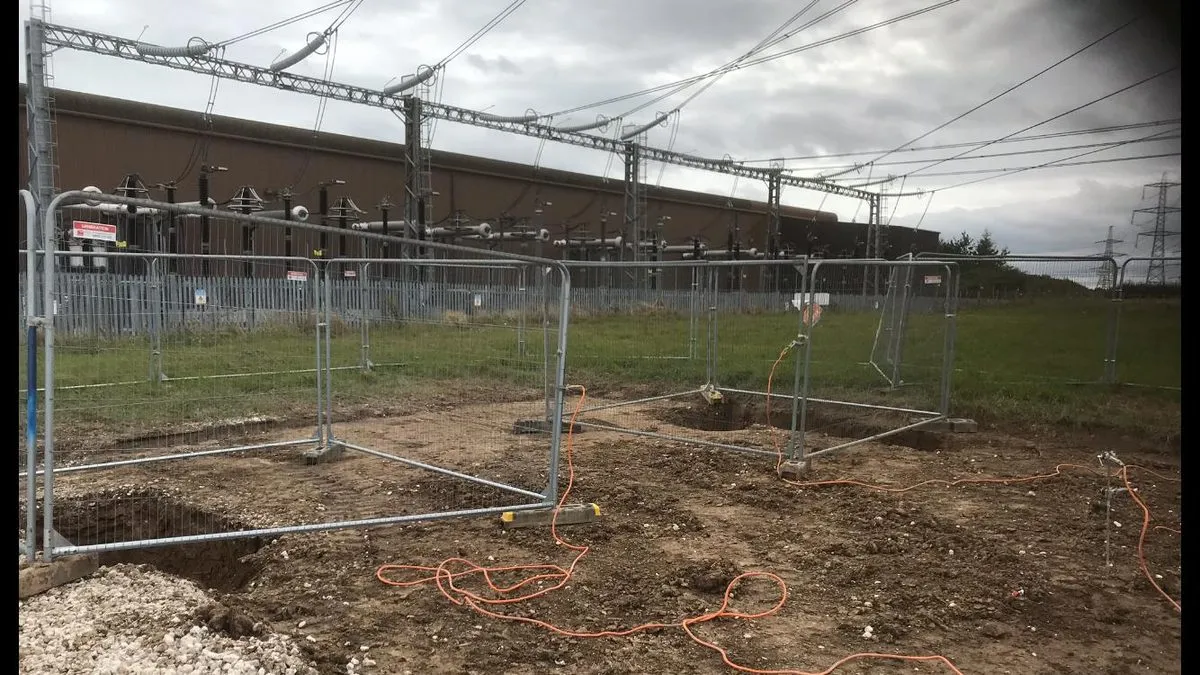
The interesting part is what was already there. The new bores had to be steered across the live HOW1 400kV cables and the Centrica 400kV cables, and pass beneath the overhead power lines on the way into the substation. Drilling lets you hold a planned, guided clearance from all of it, so the new ducts go in without anyone digging down onto live high-voltage cables.
We also kept the bore deliberately tight, 650mm for the five-duct bundle. On a high-voltage cable the ground around the duct controls how the cable sheds its heat, so a smaller, less-disturbed bore makes the thermal resistivity easier for the cable engineers to design to. The ducts were then filled with CableCem, which is designed to lower the thermal resistivity (TR) values around the cables further still. It is the sort of detail that does not show on site but matters a great deal to the people specifying the cable.
Why it mattered
This was the final connection that ties Hornsea Two into the grid, the last few hundred metres of a project that powers over a million homes. On a site like this the value of drilling is not just speed, it is being able to put a new 400kV route in among live 400kV assets without putting any of them at risk.
Both bores went in cleanly, the ducts were installed ready for the cables, and the new substation got its connection. It is the kind of work that rarely gets seen once the cables are pulled and the site is handed back, but it is exactly the sort of crossing we are built for: high-voltage, heavily constrained, and unforgiving of mistakes.
The outcome
Two cable-duct bores installed for the final 400kV grid connection of one of the world's largest offshore wind farms, steered across live high-voltage cables and under the overhead lines, with the bore held tight for the cable thermal design. The kind of high-voltage, heavily constrained crossing where directional drilling is not just the cheaper option, it is the safe one.
Questions answered
Yes. At Killingholme we directional-drilled the cable ducts for two 400kV circuits, the final grid connection for the Hornsea Two offshore wind farm. Each bore carried a bundle of three 250mm and two 125mm SDR11 ducts, the HV-grade Peak Pipes clear-duct system, that the cables are later pulled through. Drilling the ducts in keeps the cable route continuous and undisturbed, and lets it pass cleanly under and across things you could never trench through. We do the same on smaller schemes too, like the HV cable ducts we drilled for a battery-storage grid connection at Iron Acton.
Yes, and this job is a good example. The two new bores had to be steered across the existing live HOW1 400kV cables and Centrica 400kV cables, and pass beneath the overhead power lines into the substation. That is exactly the situation where directional drilling earns its place. The bore is planned and guided to hold a safe clearance from the existing assets, so the new ducts go in without anyone having to dig down onto live high-voltage cables.
On a high-voltage cable, the ground around the duct matters as much as the duct itself, because it controls how heat from the cable dissipates. The smaller the disturbed annulus around the duct bundle, the easier the cable thermal resistivity is to predict and design to. So rather than over-size the bore, we held it as tight as we sensibly could, 650mm for a three-way 250mm plus two-way 125mm bundle, to keep the thermal design clean for the cable engineers.
It depends on the duct sizes and the ground, but multi-way bundles are routine. Here each bore carried five ducts in one pull, three 250mm and two 125mm. Where a scheme needs more capacity than one bore sensibly holds, we drill more bores alongside, as we did here with one bore per 400kV circuit, kept about 8m apart.
Yes. This was the onshore grid connection for Hornsea Two, one of the world's largest offshore wind farms, delivered for Balfour Beatty and Ørsted. Trenchless installation is a natural fit for renewable connections, where cable routes have to cross live infrastructure, roads and sensitive ground to reach a substation. We have drilled cable ducts on a range of energy and grid schemes, from 400kV transmission to battery-storage connections.
Related work
The steered method behind this connection: cable ducts and pipe installed in one continuous length, under and across live infrastructure.
View →The same job on a smaller scale: HV cable ducts drilled in for a battery-storage grid connection on a live National Grid site.
View →Holding a safe clearance from live 400kV cables and overhead lines comes down to how the bore is guided.
View →Send us the route and what has to be crossed. If it can be directional drilled, across live cables, under a road or into a substation, we'll tell you honestly, with the bore designed around the cable.