Two of the first questions we get asked are “how deep can you go?” and “how far can you drill?” There is no single headline number. It comes down to the ground, the pipe size and the machinery. But there are some practical limits worth understanding before you plan a crossing.
How far can we drill?
A directional drilling bore is not capped at a set length. Short service crossings might be tens of metres, while long pipeline and river crossings run to hundreds. What you can drill comes down to the ground, the pipe size and the machinery. In practice it is usually the pull needed to draw the pipe back through the bore that reaches its limit before the rig does, which is why we do not chase extreme-length crossings for the sake of it.
For a real example, we directional-drilled a 250m crossing under the tidal River Parrett, and we have written that job up as a full case study. We are developing case studies for our longer crossings too. Our current rigs, which are in operation every day, have the capacity to drill up to around 500m, and we have access to larger machinery where a job genuinely needs it, though instances of that are very rare.
For context, the technique itself can go far further. The longest HDD crossings on record run to over 5km, on major international pipeline and harbour crossings. In the UK, crossings longer than about 300m are pretty uncommon. Where a job is expected to run that long or more, it is often safer and cheaper to break it into shorter sections than to force it in one pass. On nearly every job the length is well within reach of the kit, and there is little point pushing a bore to its limit just for the sake of it.
How deep: usually shallower than people expect
It is worth clearing up a common worry. Directional drilling does not mean deep pits and deep everything. It is common to launch and receive from pits only about a metre deep, with the bore dipping down in between to pass under whatever it is crossing. Most crossings sit somewhere in the 2m to 4m range at their deepest, and we can take a bore down to 10m or more where a job needs it.
Depth on its own is rarely a problem. What it does affect is how we track and steer the bore.
How we track the bore
How we track the drill head depends on the accuracy the job needs and the access we have.
- Walkover tracking uses a locator on the surface following a sonde in the drill head. It is quick, accurate and cost-effective, and it works deeper than many people assume, usefully to around 15m to 20m. We run a DigiTrak Falcon F5+, one of the best walkover systems available, with a sonde detection range of around 30m.
- Drill-to mode locates the head from both sides, which makes it very accurate. Where the bore is deep, or the ground risk is low and the drill has been holding grade, we can even run some rods blind, without tracking every one from the surface. We have drilled crossings of up to 100m in drill-to mode without walking over the top at any point.
- Wireline and gyro guidance put the position sensor down the drill string itself. This comes into its own on the very long crossings where there is no safe surface access at all, typically large river crossings. It is the most capable option and it costs more, usually around £3,000 to £4,000 a day for the guidance alone.
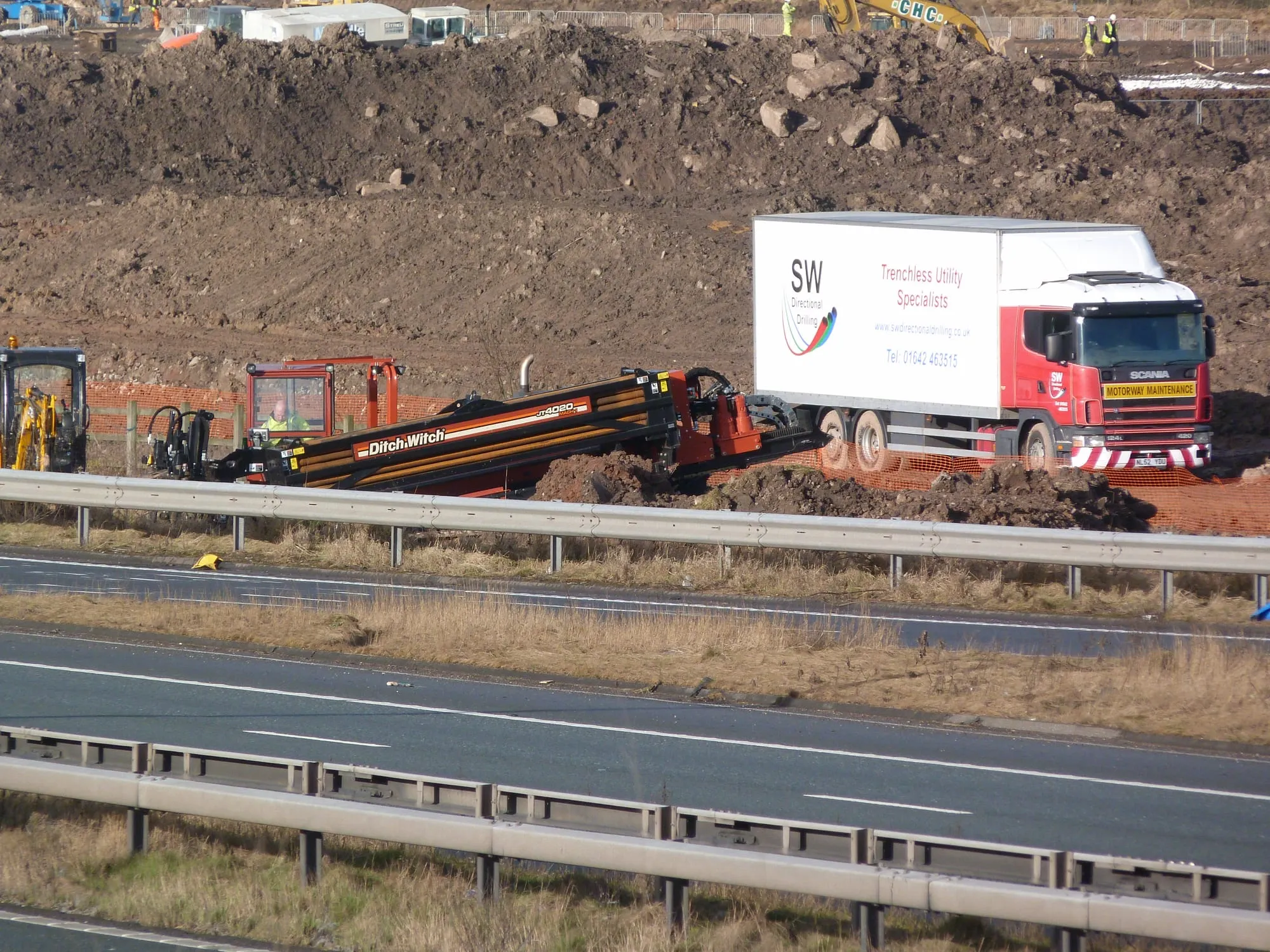
People often assume every motorway or railway crossing needs wireline or gyro. Most do not. As long as we can get to the crash barriers on each side, or run traffic management on the hard shoulders, most of these crossings are done in drill-to mode. The traffic management is often needed for surface monitoring anyway, so it does double duty. We save the downhole guidance for the long, no-access crossings that genuinely need it.
In short
Nine times out of ten, the ground, the pipe size and the machinery matter more than the raw depth or distance. We pick the tracking to suit the job so the line stays accurate without the cost running away. If you have a crossing in mind, send us the length, the depth and what you know about the ground, and we will tell you what is realistic and how we would steer it.
For more detail, read how directional drilling is steered or about horizontal directional drilling.