Est. 2005 · UK-wide trenchless installations07920 553 578·enquiries@swdirectionaldrilling.co.uk
Crossing Solutions
We drill pipes and ducts under roads of every size, from a quiet council road to a live motorway, from a pit on each side with the road left open above. Whose road it is decides the approvals, so we sort those out from the start.
Digging a trench across a road means closing it, breaking out the surface, and living with the reinstatement for years after. Drilling avoids all of that. We set up a pit on one side of the road, steer the bore underneath it, and come up in a pit on the other side, so nothing is dug in the carriageway and the traffic keeps moving above.
The drilling is much the same under any road. What changes is who owns the road and what they need from you before you can put something under it.
On a council road, work under a section 50 licence has to be supervised by an accredited street works supervisor with an accredited operative on site. Our crews hold those NRSWA tickets. The signing and guarding follows the Red Book, Safety at Street Works and Road Works, and on motorways and dual carriageways at 50mph or more it follows Chapter 8 instead. Because the road itself is never dug up, there is no trench across it to reinstate.
Approvals by road
| Private and site roads | Usually just the landowner’s agreement |
|---|---|
| Council roads | Utilities work under street works notices or permits. Anyone else needs a section 50 licence |
| Motorways and trunk roads | National Highways, with the crossing certified to CD 622 before work starts |
| Signing and guarding | The Red Book on most roads, Chapter 8 on motorways and 50mph dual carriageways |
| Street works tickets | Our crews hold NRSWA qualifications |
| Track record | 42 crossings under the live M5, the M25, M56, M40, A19 and countless council roads |
Council requirements vary, so we check the local highway authority's own conditions for each job.
See it in action
A short animated film of a crossing from start to finish. The rig sets up on one side, the pilot bore is steered down under both carriageways and up into the reception pit, the bore is opened out, and the new pipe is pulled back through.
How it is done
We set the depth for each crossing in the design, deep enough to clear the road construction and the services under the verges. On a National Highways road it also has to keep any movement of the surface inside their limit, no permanent heave or settlement of more than 10mm over 3m. More on how the bore is guided is on our steering page.
Where a route needs several ducts, we usually pull them in together as a bundle through one larger bore. Four-way, six-way and eight-way bundles under live roads are all jobs we have done, and it keeps the number of crossings, and the disruption, down.
More films
The same crossing under a single carriageway road, and a four-way duct bundle pulled in under a dual carriageway through one bore reamed out to 450mm.
On a motorway
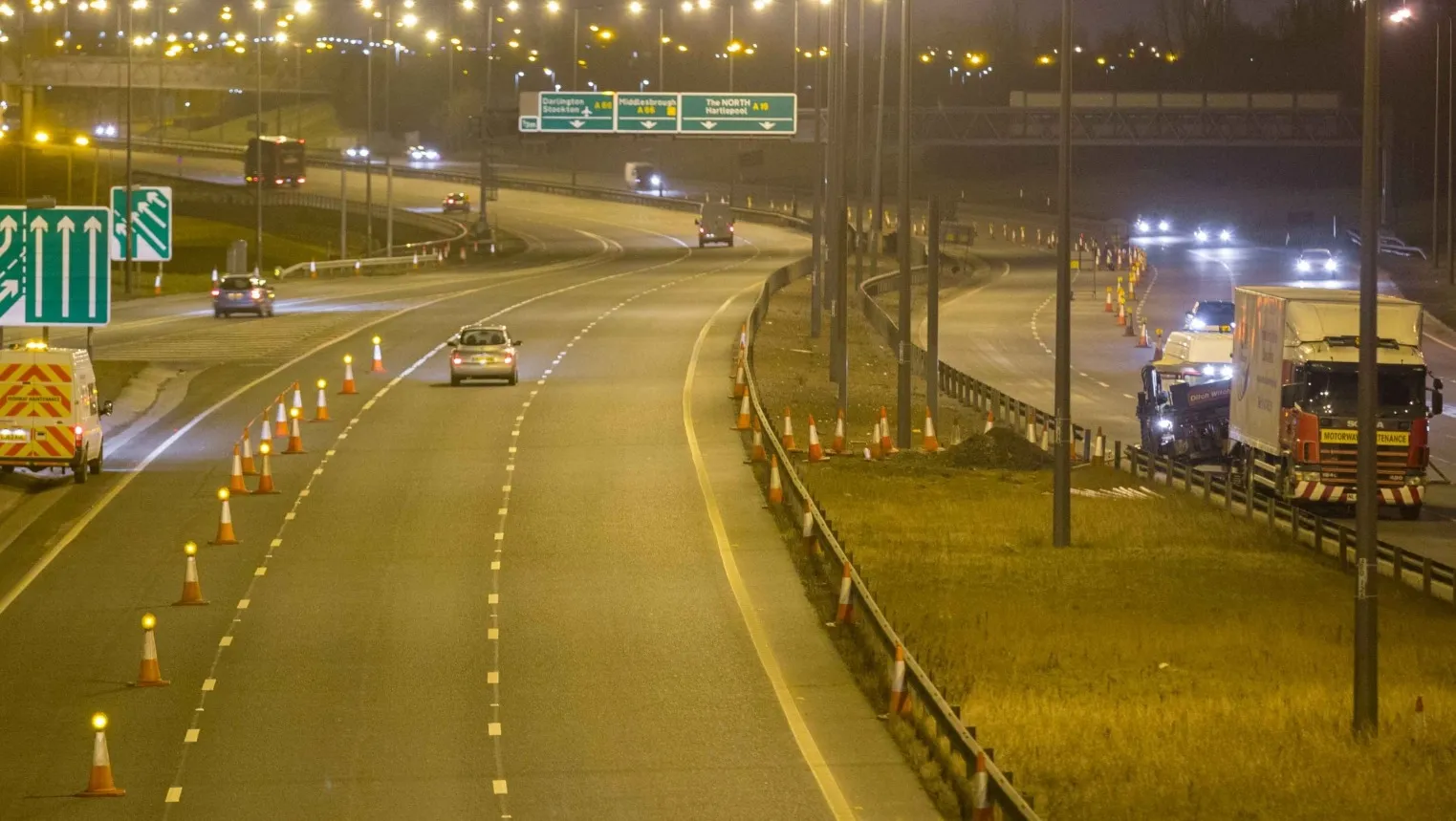
A crossing at an angle under a motorway, with the lorry and the van parked on the hard shoulders inside coned-off sections and the rig and mixing tank on the verge. Four ducts are drilled and pulled in under all six lanes in one bore, with every running lane left open.
Roads we've crossed
We drilled all 42 duct crossings under the live M5 between junctions 4a and 6 with the traffic running, and settlement was undetectable. The full story is in our M5 case study. We have crossed the M25 with a gyro where there was no safe surface access, drilled through rock under the M56, and put eleven multi-way crossings under the A19 with full CD 622 certification.
Most road crossings are smaller than that. At Iron Acton we drilled 83m under a council lane into a National Grid substation, and in Middlesbrough we put more than 40 crossings under roundabouts, slip roads and dual carriageways for a street lighting scheme. The bigger jobs are on our highway crossings page.
Questions answered
No. The crossing is drilled from a pit on each side of the road, usually in the verge or on land beside it, and the road stays open above. On a quiet council road we may need some signing or a lane closure while we work at the edge, and on a motorway we sometimes put limited traffic management on the hard shoulder so we can guide the bore from the edge. Either way it is a small fraction of the disruption of digging a trench across the carriageway.
If it is a public road and the pipe, duct or drain will be yours rather than a utility company's, yes. Under the New Roads and Street Works Act, anyone other than a statutory undertaker who wants to place apparatus in the highway, which includes under it, needs a street works licence from the council, known as a section 50 licence. The licence holder then has the same duties as a utility for that apparatus. Councils want the application well ahead, some ask for eight weeks or more, so it is worth starting early. If a utility company is the client, it works under its own street works notices or permits instead.
Deep enough to clear the road construction and the services in and under the verges, and on a National Highways road deep enough to keep any movement of the road surface inside their limit, which for the pavement is no permanent heave or settlement of more than 10mm over 3m. The depth depends on the size of the bore, the ground and the services, so we set it in the design for each crossing rather than working to one figure.
The approval. On National Highways roads the crossing has to be designed and certified to CD 622, their standard for managing geotechnical risk, before any work starts, and that runs alongside the legal consent for the apparatus. We design the CD 622 package in-house. Our CD 622 guide walks through each stage and what we need from you along the way.
It is priced per job. As a rough guide, a short small-diameter crossing under a quiet road with an easy set-up starts at around a couple of thousand pounds, while a small pipe under a motorway can run to tens of thousands once the length, depth, consents and set-up are added. Send us the location, the length and the pipe or duct size and we will give you a free budget price.
Related services
The National Highways standard for crossings under motorways and trunk roads, and how we design to it.
View service →The M5, M25, M56, A19 and more. Our record under live motorways and major roads.
View service →What moves the price of a crossing, with real budget ranges.
View service →Send us the location, the length and what you need to put under it. We'll tell you how we'd drill it, what approvals it needs, and give you a budget price.