
Est. 2005 · UK-wide trenchless installations07920 553 578·enquiries@swdirectionaldrilling.co.uk
Case Study · Highways
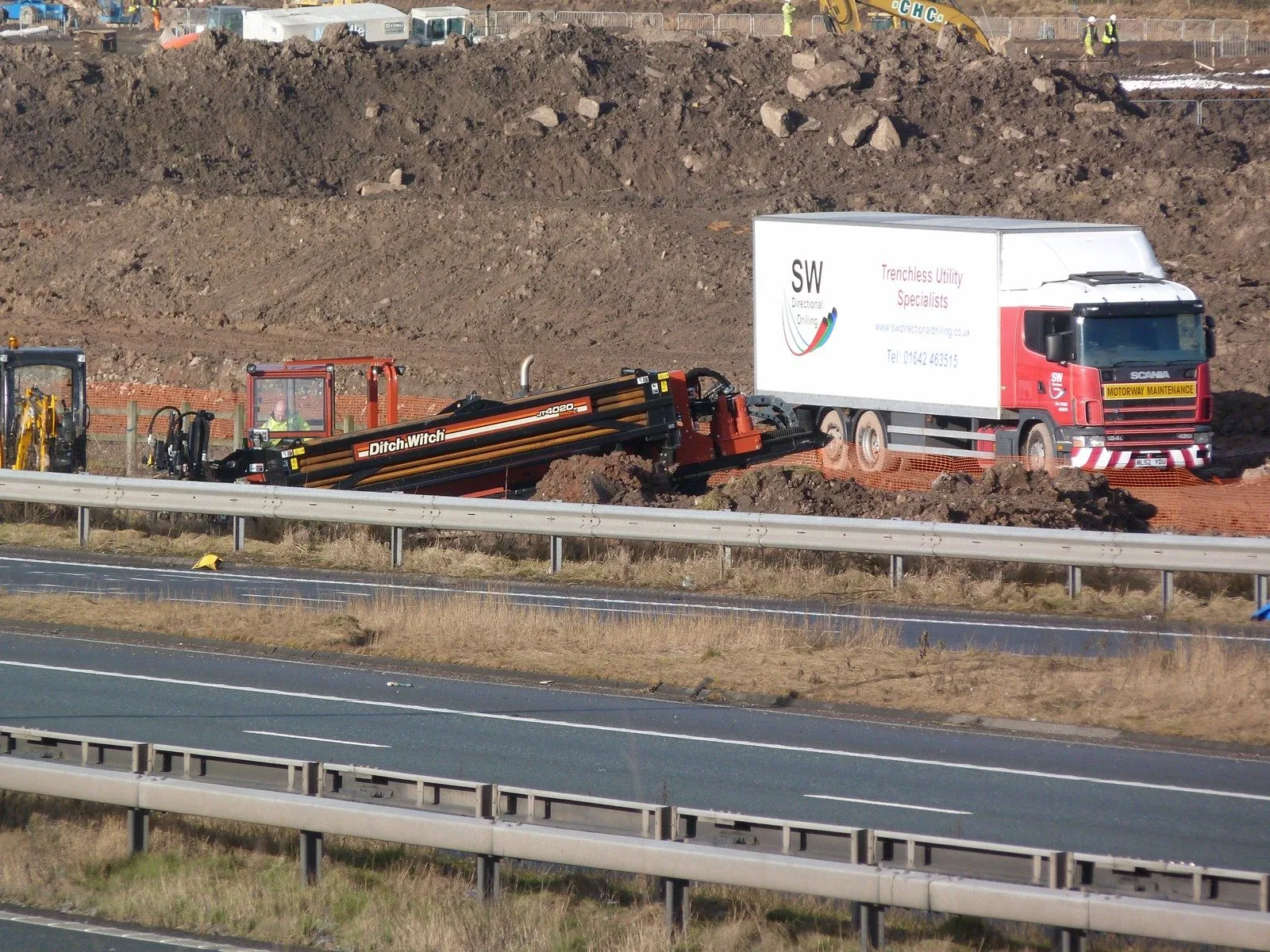
On the M5 Junction 4a to 6 smart motorway upgrade we directional-drilled 42 of 42 cross-carriageway multi-duct installations beneath the live motorway for Balfour Beatty Vinci. Every one designed to CD622, guided on walkover, drilled on night shifts, with no detectable settlement at the surface.
The job
When a stretch of motorway is upgraded to a smart motorway, all the new technology, the gantries, the sensors, the variable signs and CCTV, needs power and communications running to both sides of the carriageway. That means getting duct after duct from one verge to the other. On the M5 between Junction 4a and Junction 6 there were 42 places where the services had to cross the motorway.
The one thing you cannot do is dig a trench across a live motorway. So Balfour Beatty Vinci, delivering the scheme as a joint venture, brought us in to drill every crossing instead. We put together the package to suit the highways standards, worked out the ground and the settlement for each location, then drilled the lot from the safety of the verge while the traffic kept running overhead.
We installed 42 out of 42. Every crossing the scheme needed, drilled and handed over.
Project at a glance
| Worked for | Balfour Beatty Vinci (joint venture), on the Highways smart motorway scheme |
|---|---|
| Location | The M5 motorway, Junction 4a to 6, Worcestershire |
| Scope | 42 of 42 cross-carriageway multi-duct installations, every one completed |
| Ducts | Two-way to six-way duct bundles, most often four-way, in 125mm duct |
| Bore | Bores of 300mm to 450mm, each steered clean under the carriageway |
| Method | Horizontal directional drilling, launched from the verge, embankment or field, never touching the running lanes |
| Drill rigs | Three across the job. A JT30 (3020) rock rig, a JT60 for most installations, and a JT100 for the longest |
| Guidance | Conventional walkover / Drill-To with a DigiTrak F5, no wireline or gyro, which saved the client a lot of money |
| Design | A CD622 (then HD 22/08) settlement assessment and prediction for every individual crossing |
| Ground | Variable: gravel, rock, sand and clay along the route |
| Working hours | Around 8 weeks of night shifts, under traffic management |
| Settlement | No crossing reached its predicted settlement, none was detectable, all well within the 10mm allowable |
| Outcome | 42 of 42 delivered, on budget and ahead of programme |
Scope and settlement design developed in-house to the highways standard.
The crossings
The crossings were not all the same. Depending on what each location had to carry, they ran from two-way up to six-way duct bundles, most often four-way, in 125mm duct, with bores from 300mm to 450mm to match. The ground changed along the route too, through gravel, rock, sand and clay, so the tooling and the approach were matched to the conditions crossing by crossing rather than drilled to a single recipe.
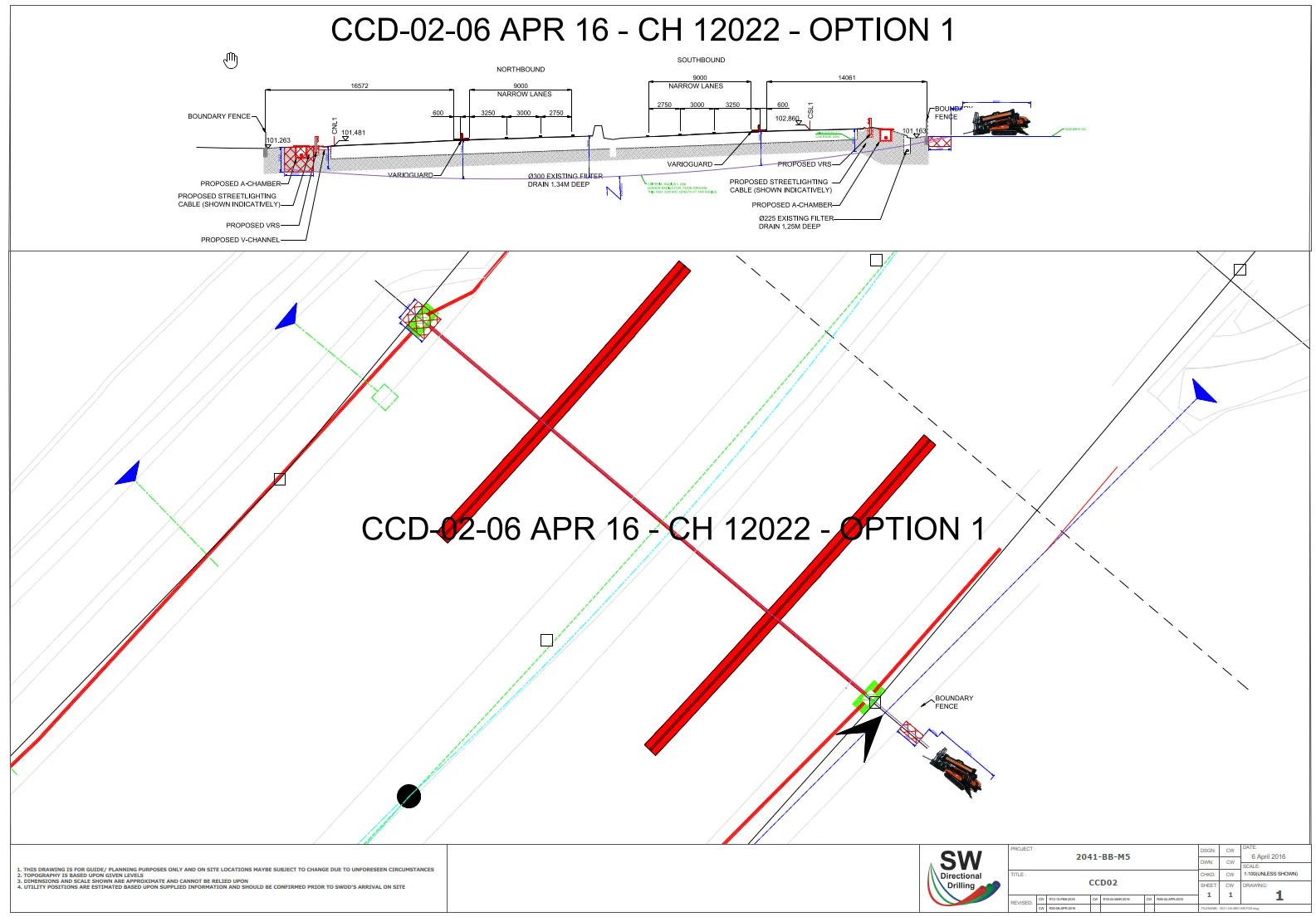
The settings varied as much as the ground. Some installations ran simply verge to verge across relatively level ground, while others sat in cuttings or ran off embankments, which changes how the rig is set up and where the bore has to launch, start and finish.
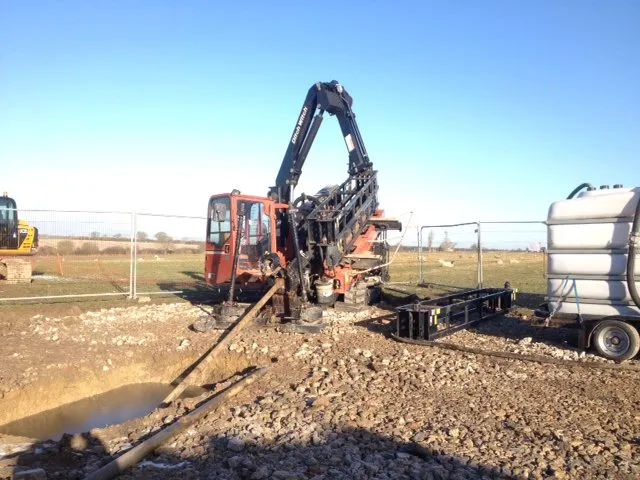
We ran three different rigs across the job, matched to the crossing and the ground: a small JT30 (3020) rock rig for the hard going, a JT60 for most of the installations, and the bigger JT100 for the longest pulls. Some were genuinely awkward. We had to steer over and under existing drainage and other live services, and keep the bore shallow at the launch and reception pits so Balfour Beatty's team could dig them out easily. On one of the harder ones the rig launched from the field at the top of the embankment, the bore dropped down to meet its start point at the foot of the embankment, and only then crossed the carriageway.
What ties a job like this together is the design. For every single crossing we produced a CD622 assessment, the highways standard for installing pipes and ducts under the road (HD 22/08 when we did the work, now CD622). It takes the ground and the depth and predicts the maximum settlement the carriageway could see, and the installation has to be shown to stay inside it. We designed and drilled each bore to do exactly that.
We guided every one of the 42 with conventional walkover, or Drill-To mode, using a DigiTrak F5 locator. Avoiding wireline and gyro steering across the whole job saved the client a lot of money, the sort of call that comes from knowing where the cost of pinpoint guidance is worth paying and where it is not.
Almost all of the drilling was done on night shifts, under traffic management, working the verges, embankments and cuttings on each side of a motorway that stayed open throughout. Around eight weeks of nights saw all 42 installations completed.
The outcome
Every crossing the scheme needed was drilled and handed over, on budget and ahead of programme. Across all 42, no installation reached its predicted settlement and none was detectable at the carriageway, comfortably inside the 10mm the standard allows. The technology got its ducts, and the traffic above never knew we were there.
Questions answered
Yes, and on a live motorway it is usually the only sensible way. At the M5 we drilled all 42 cross-carriageway crossings from the verge and embankment on each side, steering the bore underneath the running lanes without ever breaking into the carriageway. The traffic kept flowing above while we worked, mostly on night shifts under traffic management. Open-cutting a motorway to lay ducts would mean lane closures, huge reinstatement and far more risk, which is exactly why these crossings are drilled.
Settlement is the thing a road authority cares about most, so it is designed out before anyone drills. For the M5 we produced a CD622 (then HD 22/08) assessment for every single crossing, taking the ground conditions and the depth and predicting the maximum settlement at the surface. We then sized and drilled each bore to stay inside that limit. Across all 42 crossings no installation reached its predicted settlement, and none was detectable at the carriageway, comfortably within the 10mm the standard allows. Keeping the bore deep enough, the right diameter for the ground, and the drilling fluid managed is what holds the surface still.
It depends what the scheme needs. On the M5 the crossings ran from two-way up to six-way duct bundles, most often four-way, in 125mm duct, with bores between 300mm and 450mm to suit. We can install a single duct or a multi-way bundle in one bore, and where a scheme needs more capacity than one bore sensibly carries we simply drill more crossings alongside each other.
Yes. The M5 Junction 4a to 6 job was a smart motorway upgrade, and the cross-carriageway ducts we drilled carry the power and communications the technology runs on. We are set up for the constraints that come with it. Night working, traffic management, restricted verge access, embankments and cuttings, and the CD622 design and approval process highways schemes require.
On a live motorway a trench is rarely an option at all. Drilling lets the ducts go in from the safety of the verge while the carriageway stays open and undisturbed, with no excavation through the road construction and no weakening of the pavement. It is faster, far lower risk, and it leaves the surface intact, which is why directional drilling is the standard way to get services across a motorway.
Related services
The steered method behind these crossings: ducts and pipe installed under roads, motorways and railways without open-cut.
View →Guiding a bore under a live carriageway, where surface access to walk the line is limited, is a job in itself.
View →How a crossing under a road or motorway is priced, and what moves the number up or down.
View →Send us the location and what needs to go across. If it can be directional drilled, under a motorway, a major road or rail, we'll tell you honestly, with the settlement designed to the highways standard.